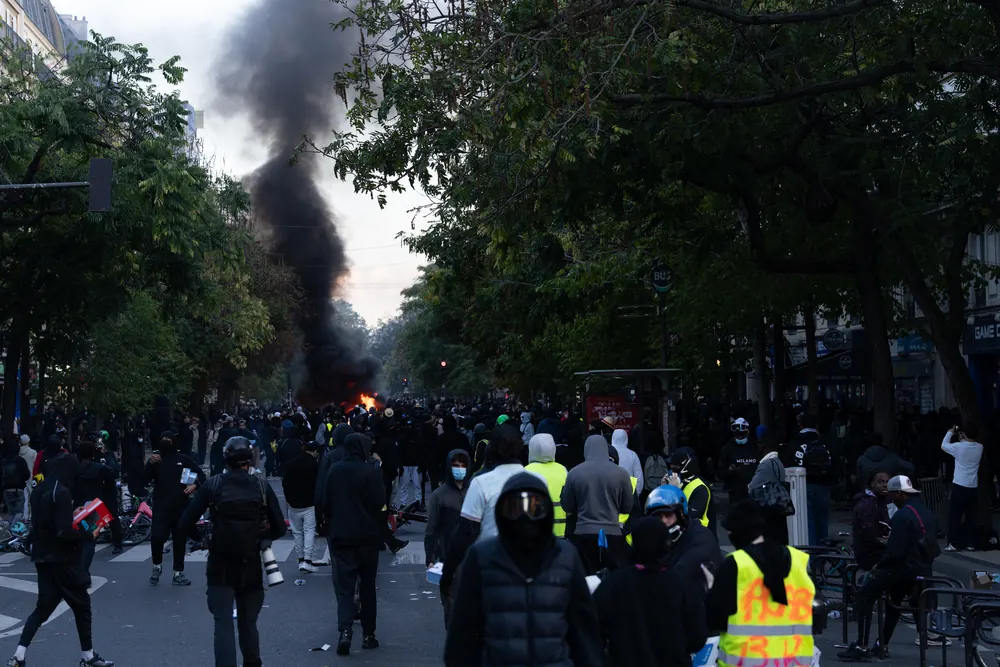
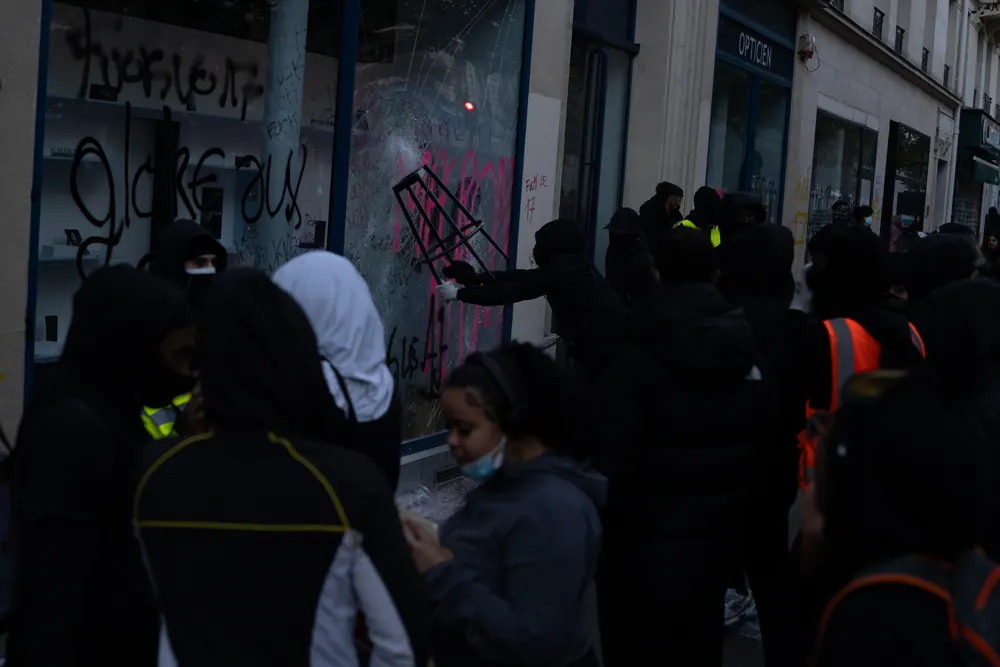
Reuters' Nov. 9 exclusive is the only located account of the restricted EU and French foreign-ministry assessments, which were not publicly available for line-by-line checking. Reuters said it could not independently verify their assertions. Public remarks from France's foreign minister and a separate Alliance4Europe study support the narrower finding that outside actors amplified and reframed the October unrest; neither independently verifies every attribution or view count in the internal documents. The EU assessment itself found no evidence that foreign actors instigated or escalated the protests. Russian and Israeli authorities did not provide substantive responses to Reuters; Moscow has previously rejected French disinformation allegations. Both photographs are actual-event images from the Paris unrest on Oct. 17, 2026, independently photographed by Jorge Jaramillo/JJxFile and licensed CC BY-SA 4.0 on Wikimedia Commons. They document the unrest, not the online campaign. Full-resolution originals are retained in public/newsroom/source-originals/france-riots-disinformation-20261109/; deployable derivatives are in public/newsroom/france-riots-disinformation-20261109/. Both were proportionally resized to 1,000 × 667, converted to WebP at quality 78 and stripped of metadata, with no crop or retouching.
False posts borrowed the appearance of news
A Russian-linked influence network used the October riots in France to circulate fabricated videos and claims, according to a restricted European Union assessment reviewed by Reuters. The document attributes the activity to Operation Overload, a campaign that has impersonated news outlets and public figures since 2023.
The posts targeted French audiences with false claims that migrants had assaulted protesters or that terrorist attacks were imminent, Reuters reported. The EU analysts said the material sought to depict France's leaders as weak and increasingly authoritarian, while linking domestic problems to the government's support for Ukraine.
The assessment made an important distinction: it found no evidence that Russia or another foreign actor started or escalated the protests. It described the campaign as opportunistic exploitation of unrest that began over living costs and public services.
Different networks drew far larger audiences
A separate French foreign-ministry assessment reviewed by Reuters examined the most-viewed X posts from Oct. 16 to 18. It put the audience for the 10 leading posts from pro-Russian circles at 2.8 million views. The equivalent totals were more than 49 million for accounts linked to the US MAGA movement and more than 35 million for Israeli officials, government accounts, media outlets and influencers.
Those figures measure views of selected posts, not unique people persuaded by them. They also do not establish that every account in a political community was coordinated. Reuters said it could not independently verify the assertions in either internal assessment.
Public evidence supports amplification, with limits
French Foreign Minister Jean-Noël Barrot said in a televised interview that actors in the United States, Israel, Iran, Russia and elsewhere had reused and distorted images from the unrest. He said two-thirds of social-media content connecting the demonstrations to immigration came from outside France. His statement is a government attribution, not an independent audit.
A separate public study by Alliance4Europe analysed 547,471 posts across six platforms and nine languages, plus 12,839 comments. It likewise found no evidence that a foreign actor originated the protests, but concluded that foreign networks amplified anger and reframed the events abroad.
Russia's foreign ministry did not respond to Reuters' request about the new assessment and has previously rejected French allegations of disinformation. Israeli authorities also did not provide a substantive response. The public record therefore supports a finding of amplification, while the precise network attributions and view counts in the restricted reports remain dependent on the agencies that produced them.
Sources
5 references
- ReutersCovert Russian network exploited French riots on social media, EU report saysExclusive reporting based on restricted EU and French foreign-ministry assessments; Reuters says it could not independently verify their assertions and records the relevant responses and non-responses. · 2026-11-09
- France DiplomacyFrance 2 interview with Foreign Minister Jean-Noël BarrotOfficial transcript in which Barrot attributes the amplification and reframing of the unrest to foreign political and state-linked communities; used as an attributed government claim. · 2026-11-02
- Alliance4EuropeHow France's October 2026 protests were manipulated, then retold abroadIndependent public study of 547,471 posts and 12,839 comments; finds foreign actors amplified anger but no evidence they originated the protests. · 2026-10-23
- Wikimedia CommonsParis riots, 17 October 2026 — Black smoke over the boulevardActual-event photograph by Jorge Jaramillo/JJxFile, own work, CC BY-SA 4.0. · 2026-10-17
- Wikimedia CommonsParis riots, 17 October 2026 — Smashed and graffitied shopfrontActual-event photograph by Jorge Jaramillo/JJxFile, own work, CC BY-SA 4.0. · 2026-10-17