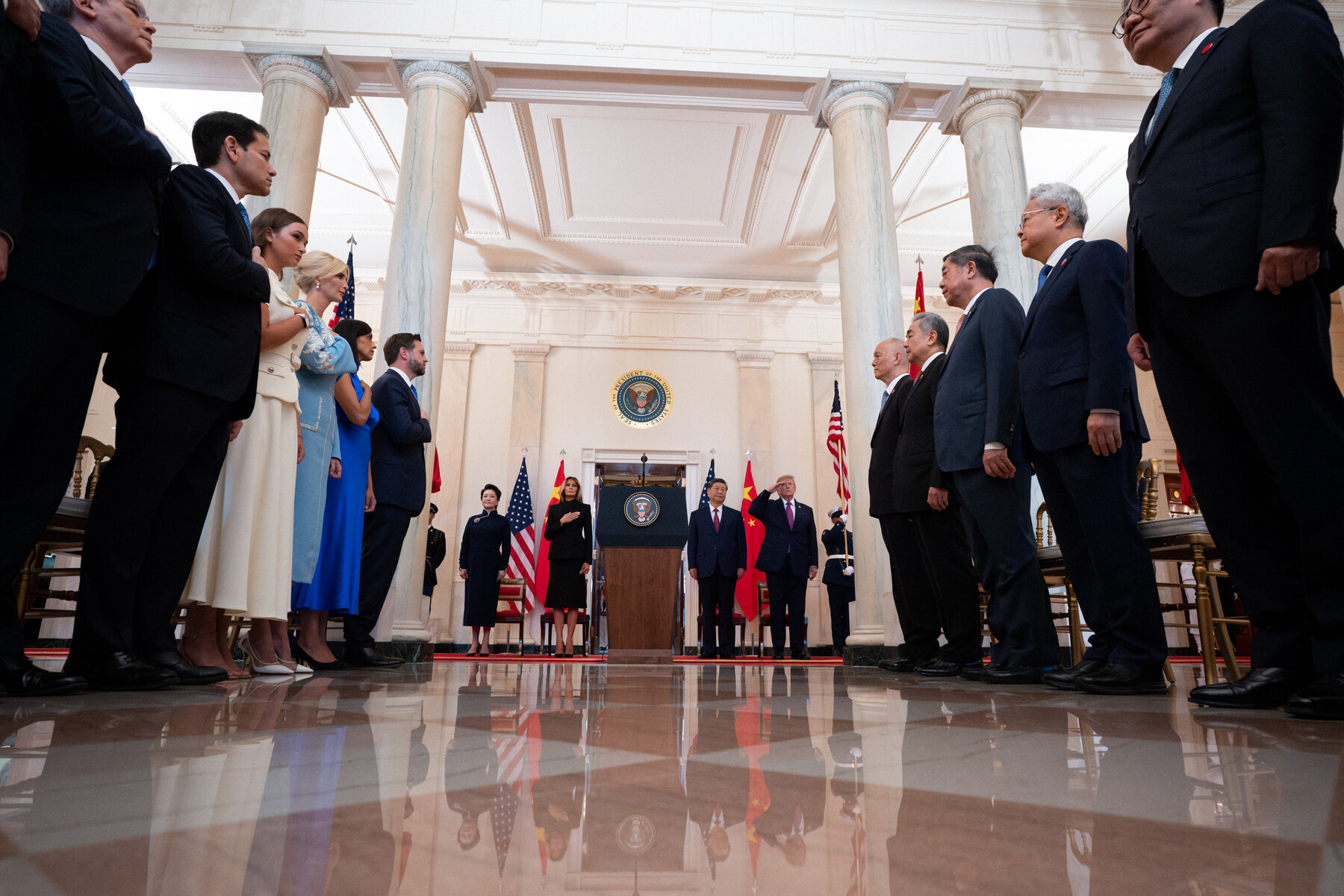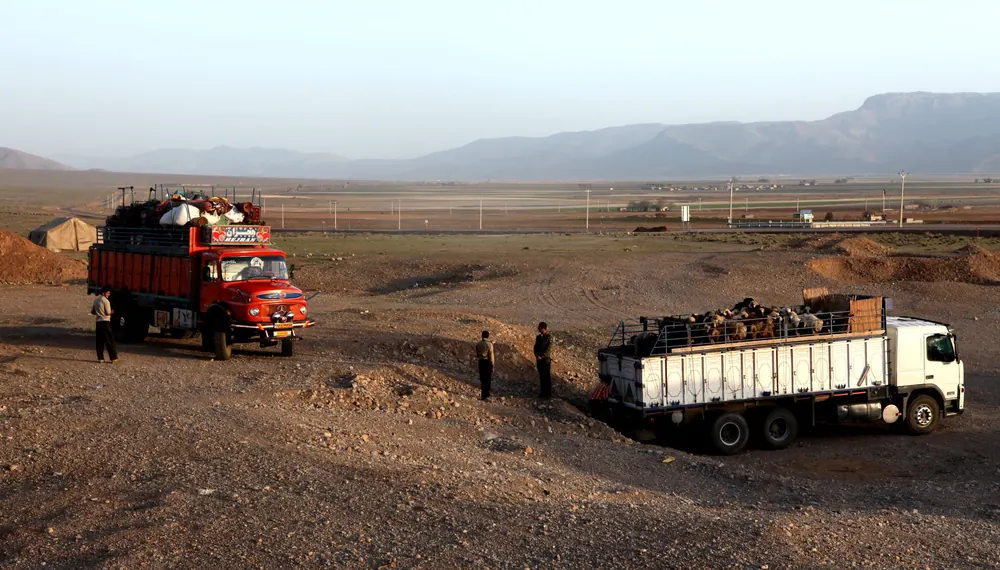
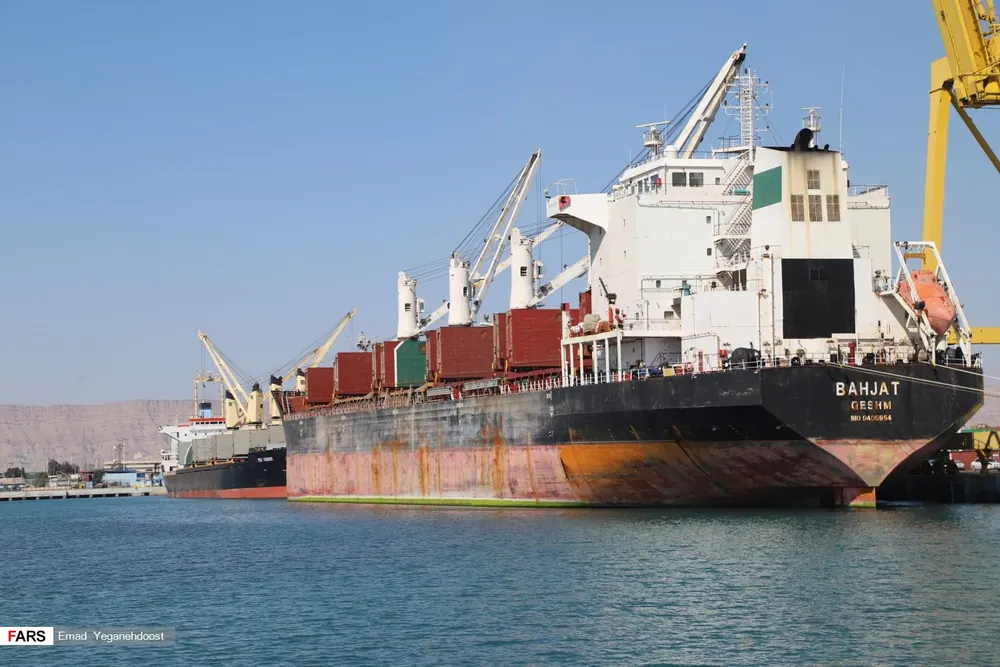
Reuters reported on Nov. 7 that the U.S. military announced Task Force Iron Gate; AP also reported CENTCOM’s announcement in its Nov. 7 regional roundup. Both accounts trace the mission to the same CENTCOM announcement, not separate evidence of results. Reuters cites an unnamed U.S. military official for the expected agency partners; no public operational order, route list, confirmed agency roster, enforcement timetable, border closure or measured outcome was located. The more-than-$25 billion blockade figure is CENTCOM’s estimate; the $2 billion import figure is from Reuters’ separate investigation. A bounded search of actual-event Reuters/AP and official imagery found no reusable photograph of the task force announcement. The two photographs are explicitly dated archive context: trucks in Fars Province on Apr. 19, 2011, by ninara, CC BY-SA 2.0; and cargo ships at Shahid Rajaee Port on Jan. 28, 2020, by Emad Yeganehdoost / Fars Media Corporation, CC BY 4.0. Full-resolution JPEG originals are included in public/newsroom/us-task-force-iron-gate-20261107/originals/ as well as retained under editorial-assets/source-originals/us-task-force-iron-gate-20261107. Both derivatives were proportionally resized to 1,000 pixels wide, converted to WebP at quality 78 and stripped of metadata; neither was cropped or retouched. Visible captions identify their dates, creators, licenses and adaptations.
A new front for sanctions enforcement
The U.S. military said on Nov. 7 that it was launching Task Force Iron Gate, a new effort to restrict the movement of advanced weapons and other material Washington says is sanctioned across Iran’s land borders and the Caspian Sea. U.S. Central Command said the unit would be based in Tampa, Florida, and coordinate with other government agencies.
CENTCOM said the effort would also target dual-use technology — equipment or know-how with civilian applications that can also serve military purposes — and what the U.S. calls illegal revenue streams. The announcement set out a mission, not evidence that a route had been shut or a shipment intercepted. No public timetable or list of targeted crossings was provided.
The announcement extends the U.S. pressure campaign beyond the naval blockade it has been enforcing around Iranian ports. Whether Iron Gate will involve inspections, sanctions designations, intelligence sharing or other measures has not been publicly detailed.
Agencies and outcomes remain unconfirmed
Reuters, which first reported the task force, quoted an unnamed U.S. military official who said expected partners included the Treasury, State and Justice departments and the intelligence community. That description was not an official roster, and CENTCOM’s public announcement did not name participating agencies.
Reuters reported that Admiral Brad Cooper, the CENTCOM commander, said interagency coordination would further constrain Iran’s ability to finance terrorism, rebuild weapons factories and replenish its military. Those are the U.S. government’s stated aims; the announcement offered no independent assessment of the unit’s future effect.
A separate Reuters investigation reported that Iran had imported at least $2 billion in hardware, explosives and heavy-duty trucks since January 2025, with shipments moving by cargo ship from Russia across the Caspian, by truck from Central Asia and by freight aircraft from China. That reporting describes routes Washington may seek to disrupt; it does not establish how much Iron Gate can stop.
The economic reach is still unclear
CENTCOM estimated that its naval blockade had prevented more than $25 billion in Iranian crude-oil exports. That figure is the command’s estimate, not an independently verified calculation published with the task-force announcement.
The new unit’s effect on ordinary commerce is also unresolved. The military has not explained how it will distinguish restricted military or dual-use shipments from lawful civilian trade moving through the same regional networks, or whether any new controls will apply at specific borders.
Sources
4 references
- ReutersExpanding on naval blockade, US military looks to restrict Iranian land commerceOriginal reporting by Phil Stewart on the CENTCOM announcement, Tampa basing and mission goals; one unnamed U.S. military official described expected interagency partners. Reuters separately attributes the blockade estimate to CENTCOM and reports findings from its investigation of Iranian imports. · 2026-11-07
- The Associated PressIran says it has lifted its self-imposed limit on missile ranges, and other Mideast newsAP’s regional roundup reports CENTCOM’s announcement that the new task force would focus on Iran’s land borders and the Caspian Sea; it does not report operational results. · 2026-11-07
- Wikimedia CommonsTrucks in Fars Province, Iran.jpg — file record and CC BY-SA 2.0 termsPhotograph by ninara, recorded as taken in Fars Province on Apr. 19, 2011; the file page records the original and Creative Commons Attribution-ShareAlike 2.0 license. Archive context only. · 2011-04-19
- Wikimedia CommonsShahid Rajaee Port 2020-01-28 23.jpg — file record and CC BY 4.0 termsPhotograph by Emad Yeganehdoost for Fars Media Corporation; the file page records its Jan. 28, 2020 date, original and Creative Commons Attribution 4.0 license. Archive context only. · 2020-01-28