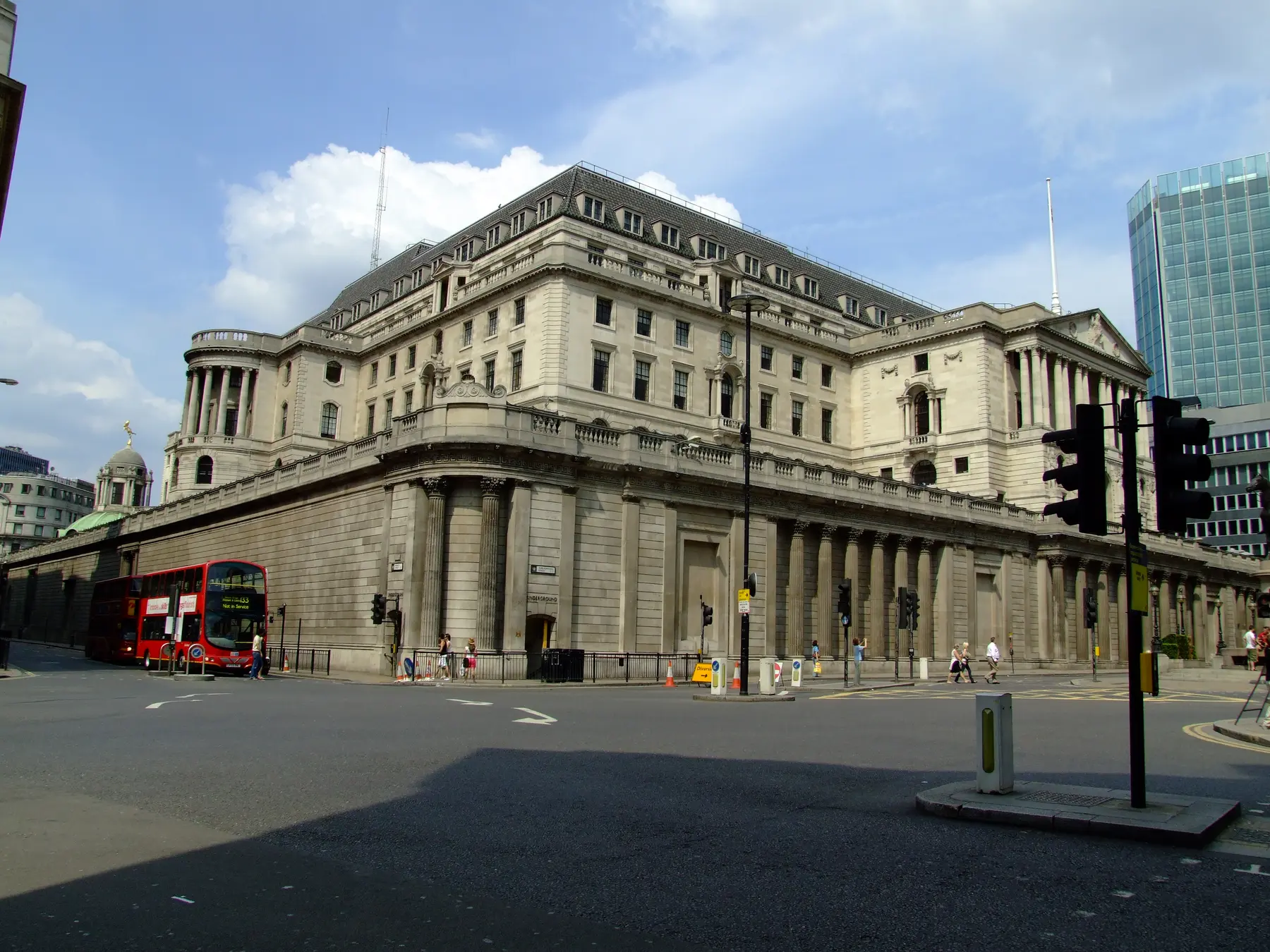
The Bank of England’s Nov. 5 summary and minutes confirm the 8–1 vote, the 0.25-percentage-point rise from 3.75% to 4%, Catherine Mann’s 4.25% vote, September CPI inflation of 3.5% and the Bank’s forecast of about 5% by mid-2027. Reuters and the Guardian independently reported the decision and its stated energy-price rationale. The Guardian’s borrower explainer, citing UK Finance, says about 510,000 tracker-mortgage borrowers would see the full increase passed through and estimates £30.72 a month for a typical £147,000 balance; variable-rate lenders can choose how much to pass on, while fixed deals do not reprice automatically. The Bank says its future decisions are conditional, not pre-set. A bounded search of official and agency images found no actual-event photo with verified reusable rights: the Bank of England’s official Flickr terms restrict general reuse to personal or non-commercial use, and Reuters imagery is licensed. These images are archive context only: the Bank building photo by R/DV/RS (July 27, 2008, CC BY 2.0) and a mortgage house-and-keys stock photo by OleksandrPidvalnyi (Pixabay, published Oct. 12, 2021, Pixabay Content License). Neither depicts the November decision or a borrower affected by it. Original files are retained in public/newsroom/source-originals/bank-rate-hike-uk-november-2026; display copies were proportionally resized and converted to WebP without cropping or content retouching.
The Bank acts as the energy shock spreads
The Bank of England raised its key interest rate by a quarter-point to 4% on Thursday, its first increase since August 2023. The Monetary Policy Committee voted 8–1 at a meeting that ended on Nov. 4; Catherine Mann voted for a larger increase to 4.25%.
The Bank said UK consumer-price inflation reached 3.5% in September and forecast it would climb to around 5% by mid-2027 as higher global energy costs feed through. That is a projection, not a measured outcome. The Bank linked the energy pressure to the prolonged Middle East conflict, while noting that evidence of broader effects on prices and wages remains limited so far.
Who feels the increase first
Bank Rate influences what commercial banks charge and pay, but a 0.25-point policy move does not change every household’s bill by the same amount. Tracker mortgages are tied to the benchmark; lenders may also raise standard variable rates. Existing fixed-rate mortgages generally keep their contracted payment until the deal ends.
The Guardian, citing UK Finance, reported that about 510,000 tracker-mortgage customers would face the full increase and estimated an extra £30.72 a month for a typical borrower with £147,000 outstanding. Lenders decide whether and how far to pass through the change to standard variable rates. The same report said roughly 2.3 million fixed-rate deals are due to end in 2027, making renewal terms more consequential for those households than the immediate rate announcement.

The next decision remains open
Higher rates are intended to restrain demand and limit the risk that costly energy, goods and services trigger further wage and price increases. They cannot lower the global price of oil or gas, and they can also weigh on borrowing, spending and business investment.
The Bank said policy is not on a pre-set path: future moves will depend on energy prices, wage growth, firms’ pricing and economic slack. Its next decision is due on Dec. 17. The committee’s divided vote shows disagreement about the size of the response, not a commitment to keep raising rates.
Sources
8 references
- Bank of EnglandMonetary Policy Summary and minutes, November 2026Primary decision record: meeting date, 8–1 vote, change from 3.75% to 4%, dissenting vote for 4.25%, September inflation and the conditional inflation outlook. · 2026-11-05
- ReutersBank of England policymakers set out views on rates outlookIndependent report of the Nov. 5 decision and individual committee members’ views on energy-price inflation risks. · 2026-11-05
- The GuardianBank of England raises interest rates to 4%, the first increase for more than three yearsIndependent reporting on the decision, its inflation rationale and the Bank’s next meeting date. · 2026-11-05
- The GuardianWhat does the UK interest rate rise mean for homeowners and savers?Borrower impact explainer citing UK Finance and Moneyfacts; distinguishes tracker, variable and fixed-rate mortgages. · 2026-11-05
- Bank of EnglandWhy have interest rates gone up in the UK?Central bank explanation of Bank Rate transmission, the energy shock, its inflation forecast and the 2% target. · 2026-11-05
- Wikimedia CommonsThe Bank of England.jpgPhoto file page identifies photographer R/DV/RS, date and CC BY 2.0 licence; historical building context. · 2008-07-27
- PixabayHouse model with keys and document for mortgage and property purchaseStock-photo page identifies creator OleksandrPidvalnyi and its publication date; historical mortgage context. · 2021-10-12
- PixabayContent License SummaryReuse terms allow free use and adaptations subject to prohibited-use restrictions; attribution is not required but is provided. · accessed 2026-11-05