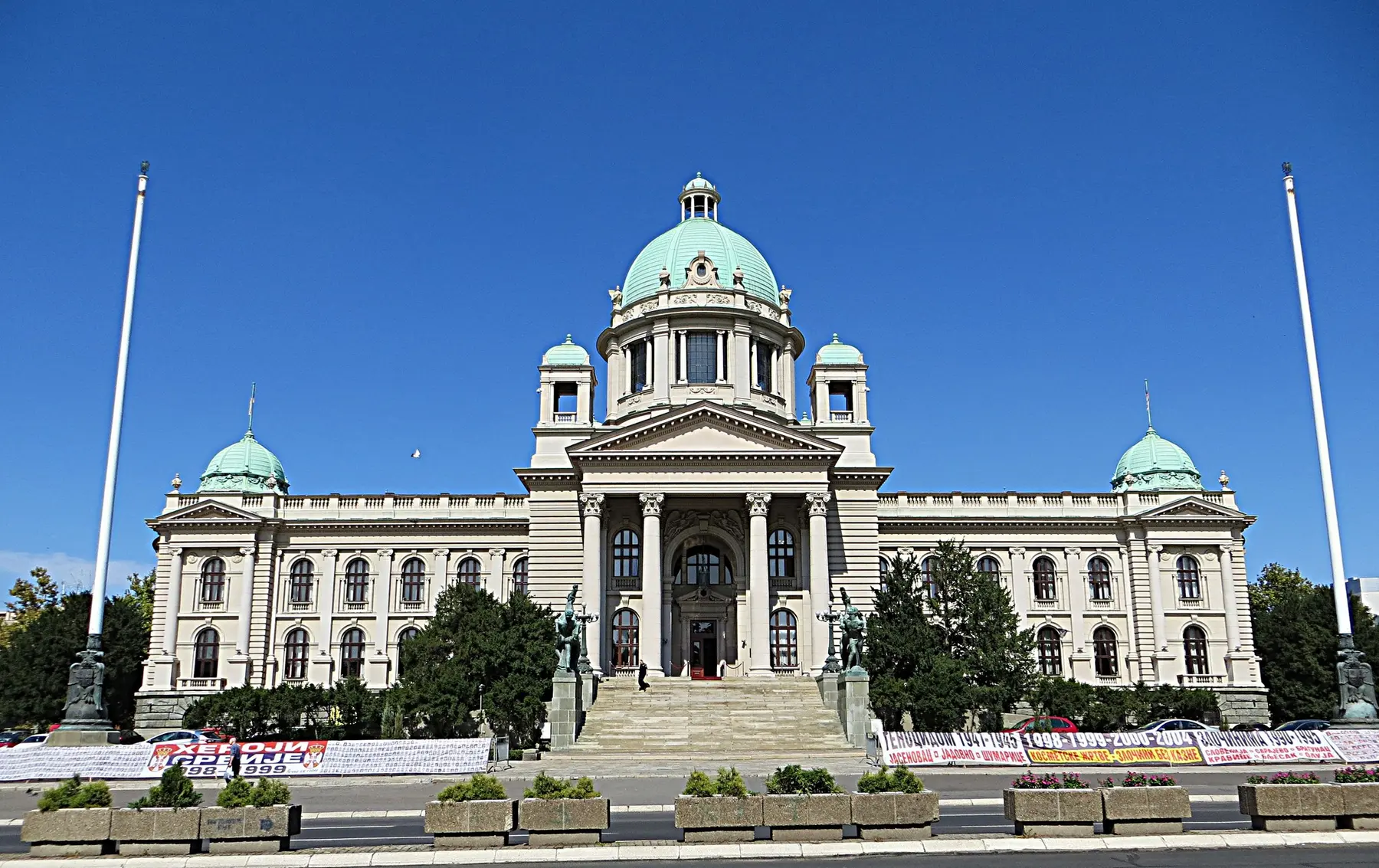
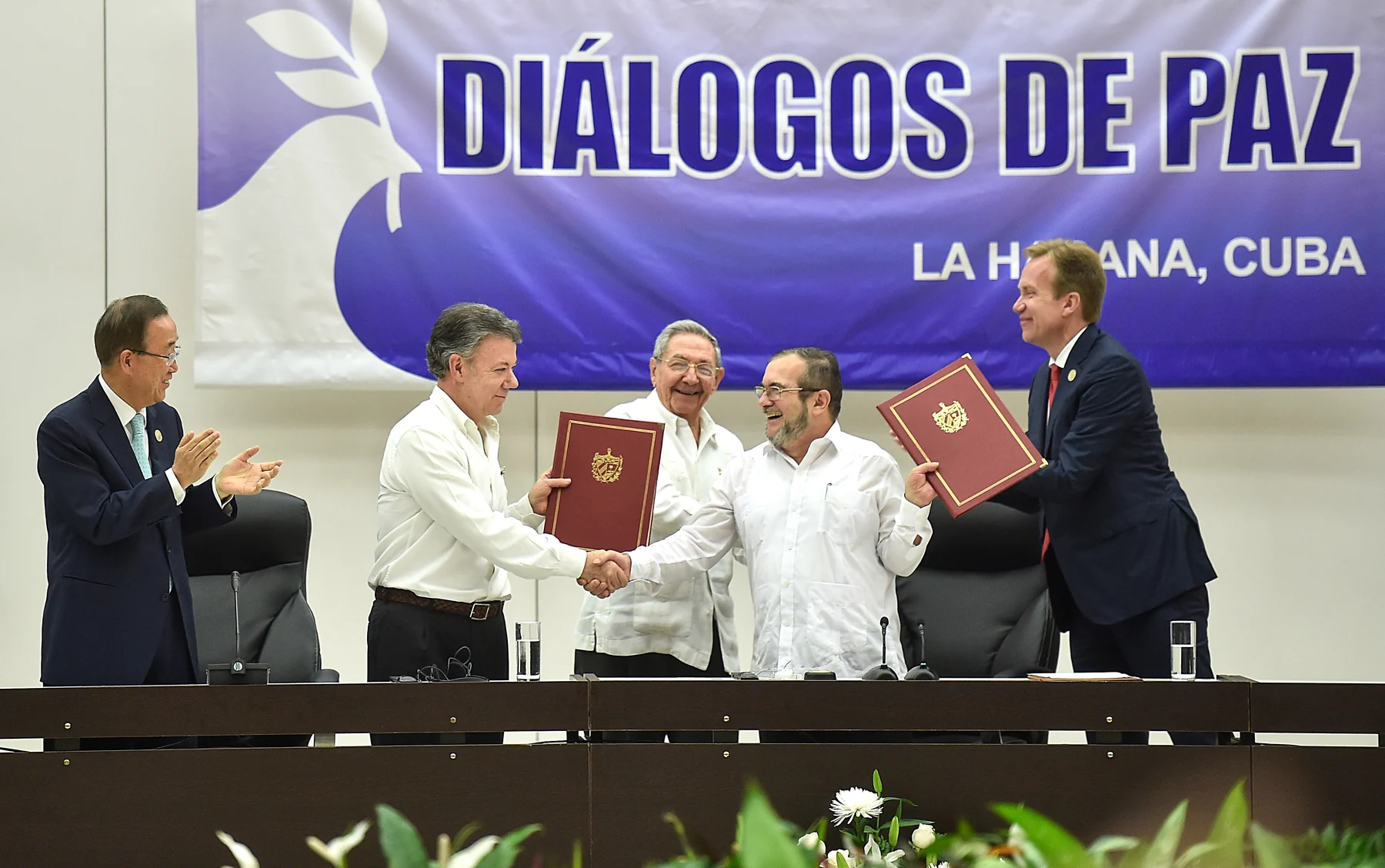
The presidency announced on Nov. 5 that Abelardo De La Espriella had sanctioned Law 2640 on Nov. 4; the presidency’s official laws index lists the law by number and date. The Senate and House published matching vote totals (57–24 and 95–10) and said both chambers adopted the same text. Reuters independently reported the bill’s requirements, sentence-reduction ceilings and that warrants, extradition and law-enforcement operations are not suspended. The House’s final-passage account says leaders face at least 10 years and collaborators six, with benefits conditional on effective cooperation and surrender of assets; it also noted unresolved timing and funding for victim reparations. Outcomes and implementation have not been assessed. A bounded search for photographs of the current debate or signing did not establish reusable rights: the Senate’s debate image is subject to reuse restrictions and the Reuters image is licensed for purchase. The two images are dated context only: Bogotá’s Congress building (June 29, 2012) and the signing of the separate 2016 FARC-government peace agreement in Havana (June 23, 2016). The original JPEGs are retained in public/newsroom/source-originals/colombia-surrender-bill-2026. Both were resized proportionally to 1,800 pixels wide and re-encoded as WebP at quality 87; neither was cropped or retouched. Captions identify their dates and state that they do not depict the 2026 law, debate or signing. Creator, source page and CC BY-SA 4.0 license are credited and linked.
A new framework takes legal effect
Colombia’s President Abelardo De La Espriella signed Law 2640 on Nov. 4, creating a new framework for armed groups that voluntarily submit to the Constitution and the law, the presidency said a day later. The official laws index lists the measure as Law 2640 of Nov. 4. It amends and extends the country’s 1997 public-order law and adds a state policy for security and territorial transformation.
The Senate approved the bill 57–24 and the House 95–10, according to the chambers. The House adopted the Senate text, so the bill did not require reconciliation before it went to the president. The government presents the measure as a shift away from former President Gustavo Petro’s “total peace” approach; that characterization is the administration’s framing of its policy change.
Sentence reductions depend on concrete cooperation
The framework sets conditions for members of illegal armed groups seeking legal benefits. Reuters reported that these include laying down weapons, identifying other members, handing over recruited or kidnapped minors, helping search for missing people, surrendering assets and providing information about political ties and corruption networks.
The final House account says benefits are tied to effective cooperation and surrender of assets. It sets minimum terms of 10 years for group leaders and six years for collaborators; Reuters reported that potential reductions can reach 50%, or 30% for commanders. These are conditional legal benefits, not an amnesty or a guarantee that any group will disarm.
Security powers remain; implementation is the test
The law does not suspend arrest warrants, extradition or law-enforcement operations, Reuters reported. Its territorial provisions also call for coordinating public agencies to replace criminal economies with legal activity and to prevent armed actors from re-forming, according to the House’s account of the text.
The House said the bill passed with questions still open about the timetable and resources for victim-reparation programs, and it noted that conditional release requires a favorable view from victims. Whether those provisions can protect victims while creating a workable path out of armed groups will depend on regulations, funding and results on the ground. The legislation sets the framework; it does not establish that violence or recruitment will fall.
Sources
7 references
- Presidency of ColombiaPresident sanctions Law 2640 of 2026 on new rules for armed-group submissionPrimary announcement: says the president signed Law 2640 on Nov. 4 and describes its new framework; the government’s laws index lists Law 2640 dated Nov. 4. · 2026-11-05
- Senate of ColombiaCongress approves submission law; House adopts Senate textPrimary legislative account: Senate vote 57–24, House vote 95–10, same text, and passage for presidential sanction. · 2026-11-04
- House of Representatives of ColombiaHouse approves extension of Law 418 and new public-order policyPrimary account of final passage and amendments; reports 10-year minimum for leaders, six years for collaborators, conditional benefits, and remaining concerns about victim-reparation resources and timing. · 2026-11-04
- ReutersColombia’s congress passes bill replacing former president’s “total peace” approachIndependent reporting on the bill’s requirements, potential sentence reductions, 10-year floor for leaders and the fact that arrest warrants, extradition and law-enforcement operations are not suspended. · 2026-11-04
- Presidency of Colombia — official laws indexLaw 2640 of Nov. 4, 2026Official listing of Law 2640 and its statutory title; the presidency announcement says it was signed on Nov. 4. · 2026-11-04
- Wikimedia Commons — image source and licenseCongress of Colombia, Bogotá.jpg by CivArmy — CC BY-SA 4.0Dated archive photograph of Colombia’s National Capitol; CC BY-SA 4.0. It does not depict the 2026 vote or signing. · 2012-06-29
- Wikimedia Commons — image source and license2016 FARC-government peace agreement signing photo by Juantenaphoto — CC BY-SA 4.0Dated photograph of a separate 2016 FARC-government peace agreement ceremony in Havana; CC BY-SA 4.0. Historical context, not an image of Law 2640. · 2016-06-23