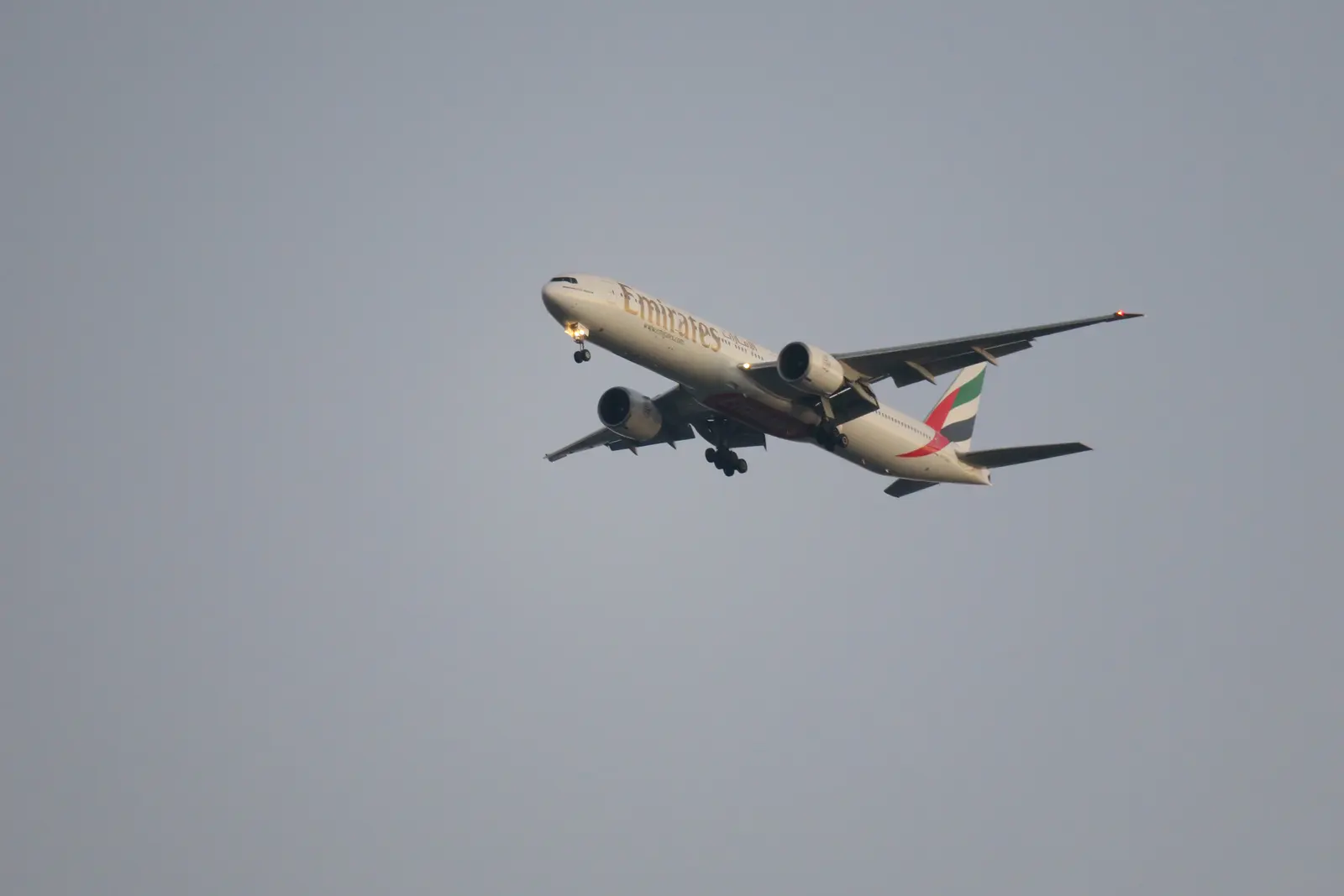
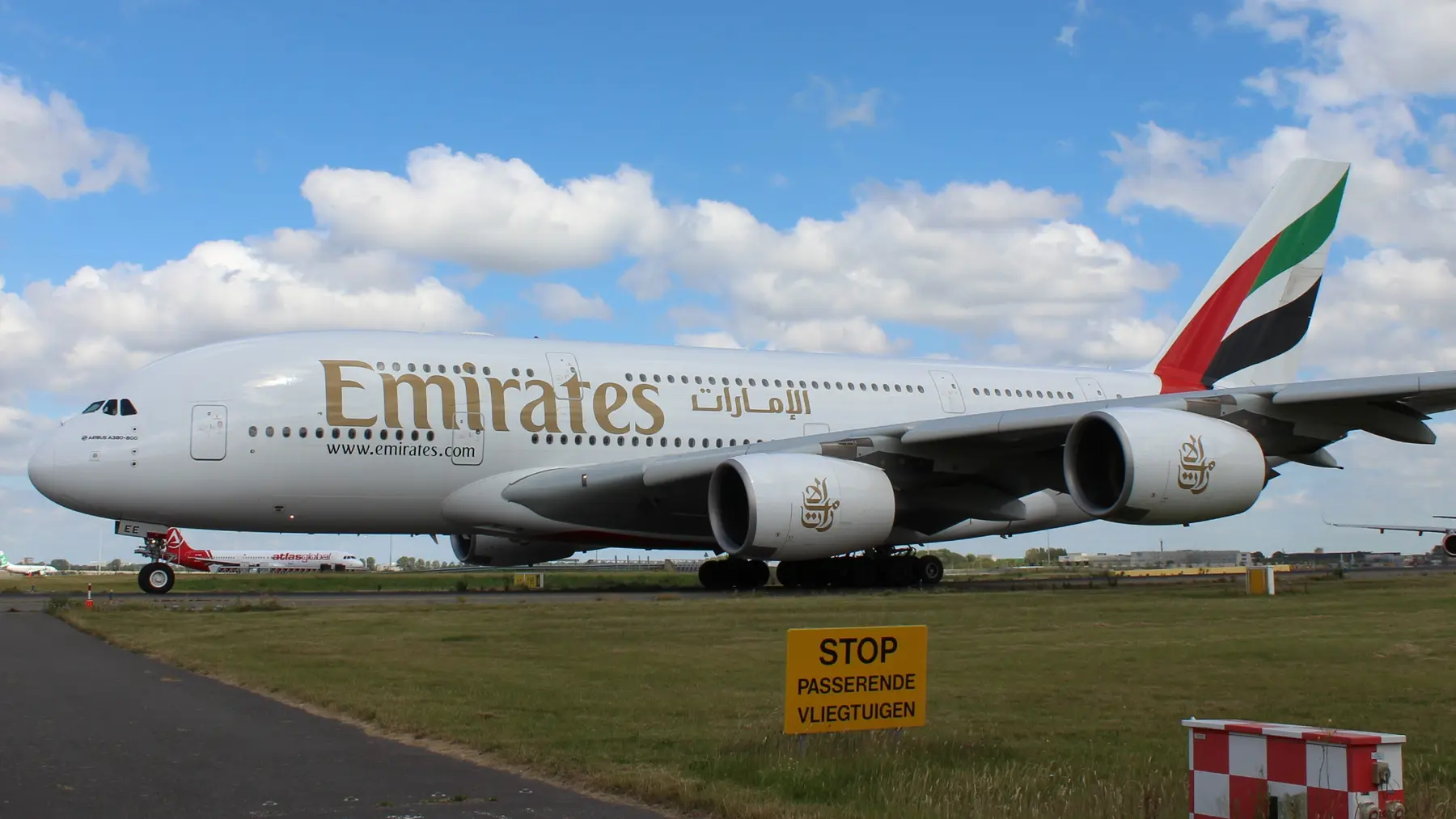
The Emirates Group’s Nov. 5 half-year release is the primary source for group-level results, cash, traffic and fuel figures. It is company reporting; Reuters independently reported the Emirates airline unit’s 66% after-tax profit decline and linked the operating pressure to regional airspace closures and higher jet fuel costs. Group and airline figures are kept separate. An initial bounded check of Emirates’ and the Group’s media libraries found event and aircraft imagery but no clear republication terms for the press images, so none is used. Both published images are dated contextual photographs, not scenes from the 2026 disruption or this results announcement: AnatolianAviator’s Emirates 777 approaching Lisbon on March 31, 2026 (CC BY 4.0), and Styyx’s Emirates A380 at Amsterdam Schiphol on Feb. 21, 2020 (CC BY-SA 4.0). Original JPEGs are retained in public/newsroom/source-originals/emirates-h1-results-2026. The lead was proportionally resized from 5,472 × 3,648 to 1,600 × 1,067 and converted to WebP at quality 84; the inline image was proportionally resized from 3,140 × 1,767 to 1,800 × 1,013 and converted at quality 84. No crop or content retouching was applied; the inline derivative is shared under CC BY-SA 4.0.
A profitable half-year with a sharp year-on-year drop
The Emirates Group reported AED 3.6 billion (about US$1 billion) in net profit for the six months to Sept. 30, down 66% from the same period a year earlier. The Dubai-based parent group’s revenue fell 12% to AED 66.2 billion. It also reported AED 4.1 billion in profit before tax.
The parent’s results combine the Emirates airline with dnata, its airport, catering and travel-services business. The airline alone reported AED 3.3 billion in net profit after tax, also 66% lower, and revenue of AED 56.9 billion, down 13%. Keeping the two sets of figures separate matters: the wider group includes businesses beyond passenger flights.
Routes returned faster than passenger volumes
Emirates said it was operating 91% of its pre-disruption network by Sept. 30, but carried 21.8 million passengers in the half-year, 22% fewer than a year earlier. Available seat capacity was down 17%, and the share of seats filled fell to 72% from 79.5%.
The figures show that restoring routes did not mean returning to prior traffic levels. The company attributed the strain to intermittent airspace restrictions and closures, government travel advisories and changes in travel flows. Its cargo business carried slightly less tonnage than a year before, but cargo revenue rose 52% as the conflict disrupted airfreight capacity and marine transport.
Fuel hedges softened, but did not erase, the cost shock
For the airline, fuel costs before gains from its risk-management strategy rose 60% year on year even as fuel uplift fell with fewer flights. The company said AED 7.1 billion in hedging gains limited the net increase in fuel costs to 13%. Hedging uses contracts to reduce exposure to sudden price changes; it can cushion a rise without preventing it.
The group’s cash position was AED 54.1 billion at the end of September, compared with AED 59.6 billion at the end of March. Emirates said it had used reserves for business needs including aircraft pre-delivery payments and debt obligations. Its chairman described the outlook for the second half as measured optimism, while saying the group would watch costs and geopolitical developments.
Sources
4 references
- The Emirates GroupEmirates Group announces half-year profit for 2026-27 despite regional conflict and high fuel costsPrimary company release for the group’s first-half figures, April-September operations, passenger volumes, fuel costs and cash position. · 2026-11-05
- ReutersEmirates profit plunges as Iran war rattles Middle East aviationIndependent reporting on Emirates airline’s 66% after-tax profit decline, lower passenger volume and regional airspace and fuel-cost pressures; distinguishes the airline from its parent group. · 2026-11-05
- Wikimedia Commons / AnatolianAviatorEmirates Boeing 777 approaching Lisbon Airport from Dubai, March 31, 2026Dated archive-context photograph; photographer’s own work, licensed CC BY 4.0. · 2026-03-31
- Wikimedia Commons / StyyxEmirates A380 at Amsterdam Schiphol, February 21, 2020Dated archive-context photograph; photographer’s own work, licensed CC BY-SA 4.0. The adapted WebP derivative is shared under the same license. · 2020-02-21