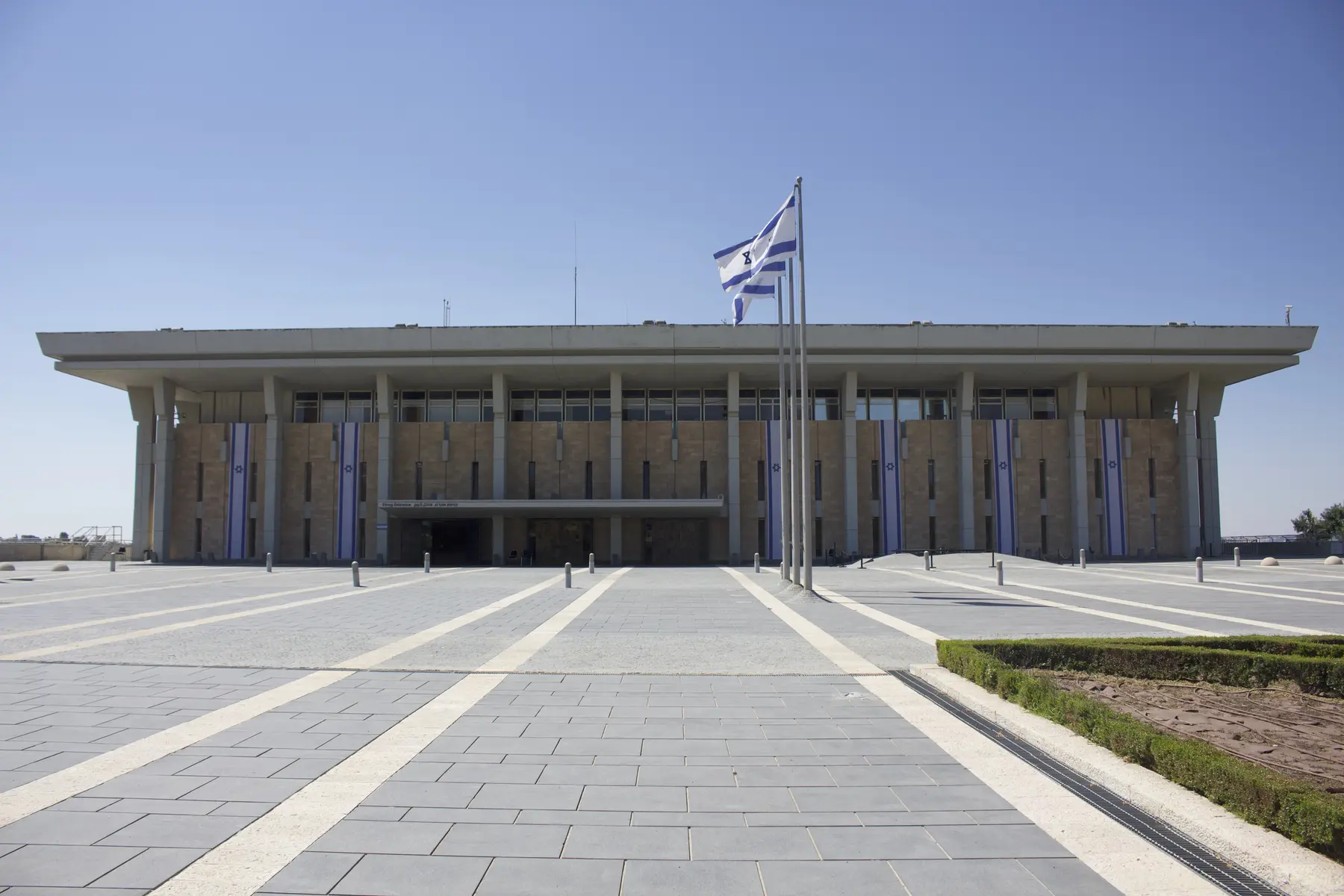
The Israeli President’s Office confirms the consultation recommendations—factions representing 67 members supported Gadi Eisenkot, 46 supported Benjamin Netanyahu and one seven-member faction recommended no one—and says the formal task carries 28 days plus a possible 14-day extension. Those recommendations are not a confidence vote or coalition agreement. AP and Reuters independently report the formal handover on Nov. 8 and that the Oct. 27 election left no bloc with 61 seats. Reuters supplies the seat arithmetic and describes possible coalition routes; those are political options, not commitments. The appointment does not make Eisenkot prime minister. The official presidency page identifies its ceremony photograph as credited to Arnon Bossani but provides no open reuse license; AP marks its event images as licensable. No current-event image with verified open reuse terms was used. The two images are dated context photographs of the Knesset and President’s Residence, not images of the Nov. 8 meeting. Lead by Clema12 (July 3, 2022), CC BY-SA 4.0; inline by Mark Neyman / Government Press Office of Israel (May 17, 2017), CC BY-SA 3.0. Original JPEGs and rights records are retained in public/newsroom/source-originals/israel-coalition-mandate-20261109. Each was proportionally resized to 1,800 px wide, converted to WebP quality 86 and stripped of metadata; neither was cropped or retouched. Each derivative is provided under its respective share-alike license.
A mandate is not a government
Israeli President Isaac Herzog formally gave opposition leader Gadi Eisenkot the first chance to form the country’s next government on Sunday, Nov. 8. The step starts a 28-day period for coalition negotiations, with a possible extension of up to 14 days. It does not make Eisenkot prime minister: he must assemble a government able to win the Knesset’s confidence.
The Oct. 27 election left no bloc with an outright majority. Herzog’s consultations gave Eisenkot the first attempt because a majority of lawmakers recommended him as the candidate most likely to assemble a government, the president’s office said. Those recommendations are political signals, not a coalition agreement or a parliamentary confidence vote.
The numbers leave several routes—and vetoes
Israel’s parliament, the Knesset, has 120 seats; a bloc generally needs 61 for a majority. Likud remained the largest single party with 27 seats, but Reuters reported that Prime Minister Benjamin Netanyahu’s broader coalition bloc held 53. Eisenkot’s Yashar party won 21, while the four-party grouping supporting him totaled 48. Arab-led parties won a combined 19 seats, Reuters reported.
The figures point to a fragmented parliament rather than an obvious governing partner. Eisenkot could seek a minority government that relies on Arab-party support for key votes, try to bring ultra-Orthodox parties into a coalition, or negotiate a unity government with Netanyahu. Reuters reported that each route faces political obstacles and that some opposition leaders have ruled out particular combinations.
The presidency’s role is limited but consequential
Israel’s president does not choose the prime minister by election. After consulting parliamentary factions, Herzog assigns the task to the member of Knesset he judges most likely to form a government. The selected lawmaker then negotiates with parties and must secure the Knesset’s backing.
The president’s office recorded recommendations from factions representing 67 members for Eisenkot, 46 for Netanyahu, and no recommendation from a seven-member faction. Herzog said the totals did not by themselves resolve which candidate could build a stable government, citing mutual vetoes within and between the political blocs.
Policy stakes extend beyond coalition arithmetic
The negotiations will determine who sets Israel’s policy while the country faces continuing security and regional questions. Reuters reported that Herzog cited the threat from Iran, the need to advance toward peace in Gaza and negotiations with Lebanon and other neighbours. The possible partners differ over security, religious policy and the role of Arab parties, making the coalition talks consequential beyond the identity of the next prime minister.
AP reported that Eisenkot described the process as complex and promised a government that represents different parts of society. Whether that language can translate into a workable parliamentary majority remains unsettled.
A fallback remains possible
If Eisenkot cannot form a government within the allotted period, Herzog could give Netanyahu the next opportunity. Reuters reported that if Netanyahu also fails, a new election could follow. That sequence is not automatic proof that either candidate can assemble a majority; it describes the remaining constitutional path as parties negotiate.
The immediate measure of success will be an agreement capable of surviving a Knesset confidence vote. Until then, the president’s mandate marks the start of coalition bargaining, not the end of Israel’s political deadlock.
Sources
4 references
- President of IsraelHerzog says he will task Gadi Eisenkot with forming a governmentPrimary account of the president’s intent, consultation recommendations and the 28-day formation period with a possible 14-day extension. · 2026-11-07
- President of IsraelPresident Herzog concludes consultations with Knesset factionsPrimary record of the faction recommendations: 67 members for Eisenkot, 46 for Netanyahu and a seven-member faction making no recommendation; Herzog said recommendations alone did not settle who could form a stable government. · 2026-11-05
- Associated PressIsrael’s president gives Eisenkot the first chance to form the next governmentIndependent reporting on the formal appointment, election outcome and coalition obstacles; AP’s event photographs are separately licensed. · 2026-11-08
- Reuters, republished by Investing.comNetanyahu rival Eisenkot seeks “wide” government but path to power uncertainIndependent Reuters report on the coalition arithmetic, Eisenkot’s stated goal and the potential paths and obstacles to forming a government. · 2026-11-08