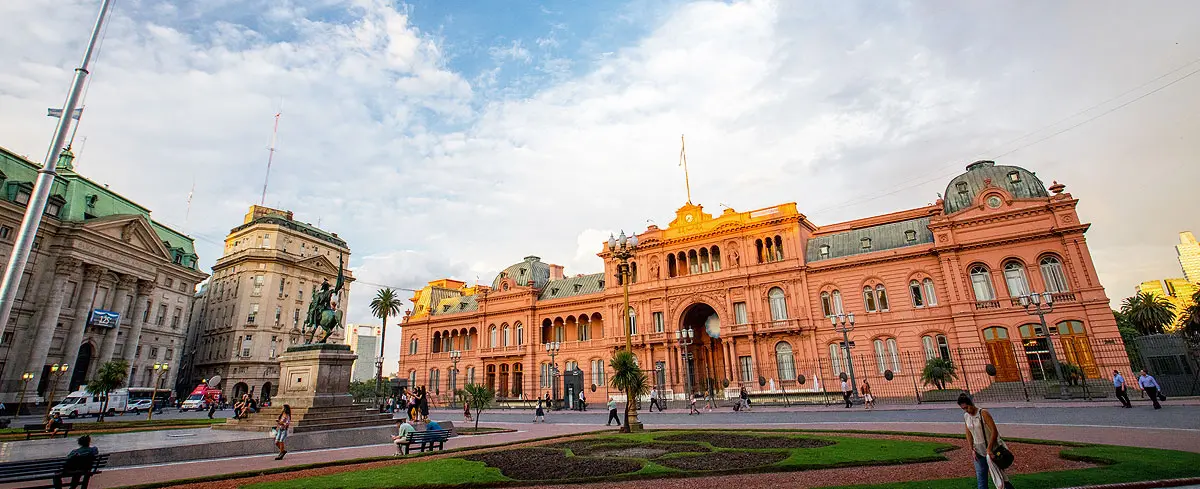
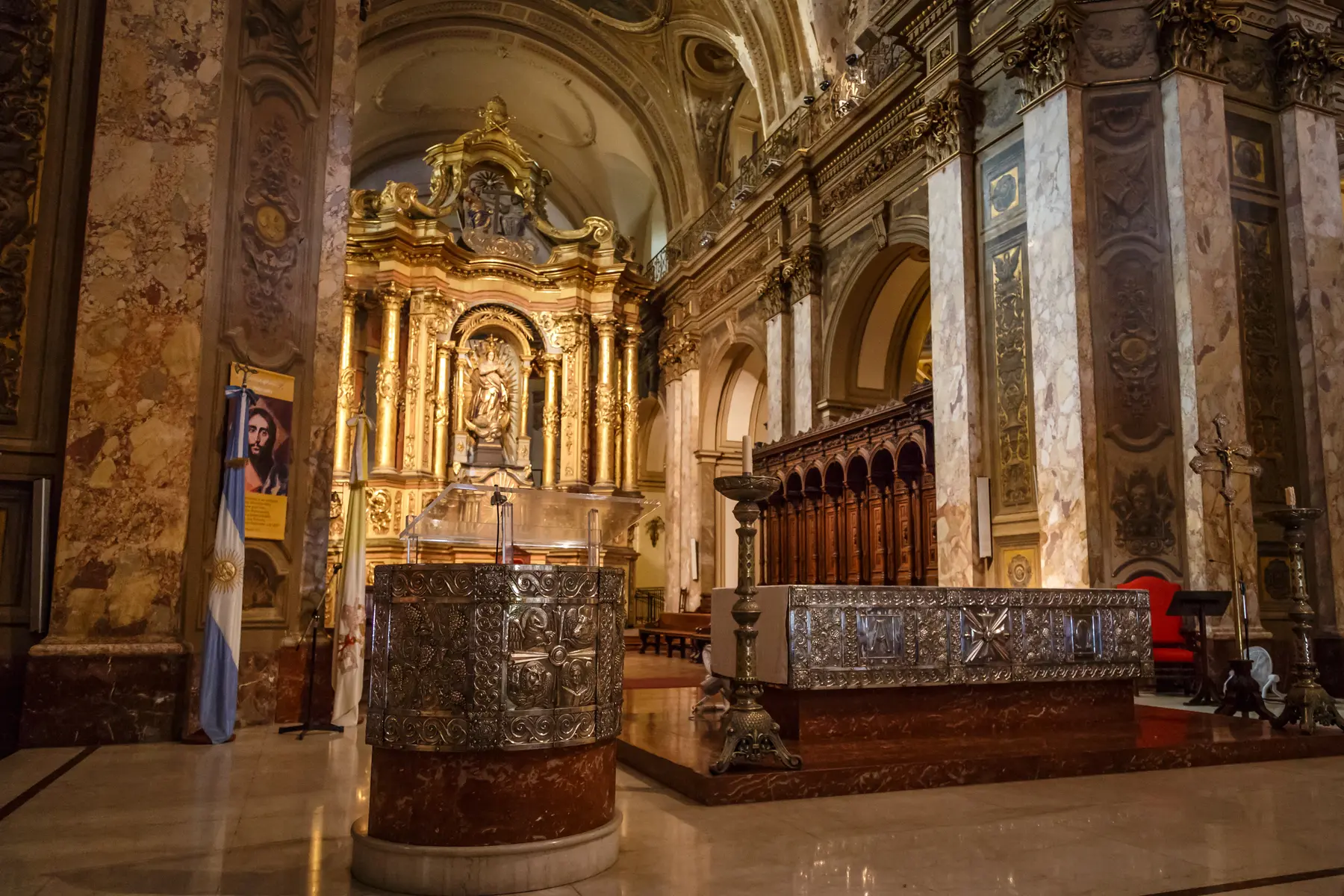
The Holy See programme confirms the venue, audience and scheduled address on Nov. 8; Vatican News reports the substance of Leo’s remarks. Reuters independently reports that Leo did not name Javier Milei or his austerity plan and supplies the domestic political context. The article distinguishes the Pope’s stated principles from interpretation of their relevance to Milei’s policies. A bounded actual-event photo search found Vatican Media material without clear reuse terms and agency images requiring a licence; neither is used. The two images are dated archive context only: Casa Rosada (2019), the executive seat, and Buenos Aires Metropolitan Cathedral (2013); neither depicts the address or its venue. Original files and source/licence records are retained in public/newsroom/source-originals/pope-argentina-debut-20261108. Casa Rosada photo by Gobierno de la Ciudad Autónoma de Buenos Aires (CC BY 2.5 AR), 1,200 × 489; no resizing or crop, converted to WebP quality 86 with metadata stripped. Cathedral photo by Barcex (CC BY-SA 3.0), original 4,974 × 3,316; proportionally resized to 1,800 × 1,200 and converted to WebP quality 86 with metadata stripped. No retouching; visible captions identify the archive dates, creators and licences. The article uses the first image as its lead/thumbnail and the second as a separate inline image.
A call to limit power and broaden growth
Pope Leo XIV used his first address in Argentina on Sunday to urge democratic restraint and say economic growth should benefit people in hardship, placing questions of power and social responsibility at the centre of a closely watched visit to President Javier Milei’s country.
Leo spoke at Palacio Libertad in Buenos Aires to government authorities, civil society representatives and diplomats. The Holy See’s programme lists the gathering and an address; Vatican News reports that he emphasized dialogue, the limits of political authority and an economy that serves people.
The Pope did not name Milei or his austerity programme, Reuters reported. His remarks therefore set out principles rather than a direct public rebuke of a particular policy.
Social costs enter the political backdrop
Leo’s comments came as Milei’s government pursues spending cuts and a market-oriented economic programme. Reuters reported that the president used his own welcome to defend libertarian policies and constitutional rights. The exchange placed competing ideas about the state and economic policy in the same public setting, without establishing that Leo was addressing a specific measure.
Vatican News’s account of the Pope’s remarks also points to families living with uncertainty, people unable to meet basic needs despite working, job-seekers and older people. Leo connected those concerns to education and research, opportunities for young people, ethical responsibility in artificial intelligence and care for natural resources.
A first visit in nearly four decades
The address was part of Leo’s first visit to Argentina as pope and the middle stop of a 12-day journey through Uruguay, Argentina and Peru. Reuters described it as the first papal visit to Argentina since 1987.
The distinction matters: the Vatican’s report records what Leo said, while questions about how his language relates to the government’s policies remain interpretation. His address offered no specific policy prescription or announced change in Church–state relations.
Sources
5 references
- Vatican NewsPope Leo XIV meets authorities in Buenos AiresOfficial Vatican News account of the Nov. 8 address, its themes and the audience at Palacio Libertad. · 2026-11-08
- ReutersPope Leo heads to Milei’s Argentina as tensions loom over austerityIndependent reporting on the address, its political context, and the fact that Leo did not name Milei or a specific policy. · 2026-11-08
- Holy See Press OfficeApostolic Journey of Pope Leo XIV to Uruguay, Argentina and Peru — ProgrammePrimary itinerary confirming the Nov. 8 meeting with authorities, civil society and diplomats at Palacio Libertad, including an address. · 2026-09-21
- Wikimedia Commons / Gobierno de la Ciudad Autónoma de Buenos AiresPanorama Casa Rosada fachadaArchive-context photograph of Argentina’s executive seat; CC BY 2.5 AR. Does not depict the Nov. 8 address. · 2019
- Wikimedia Commons / BarcexCatedral Metropolitana de Buenos Aires — 9 March 2013Archive-context photograph of the cathedral interior; CC BY-SA 3.0. Does not depict the Nov. 8 address. · 2013-03-09