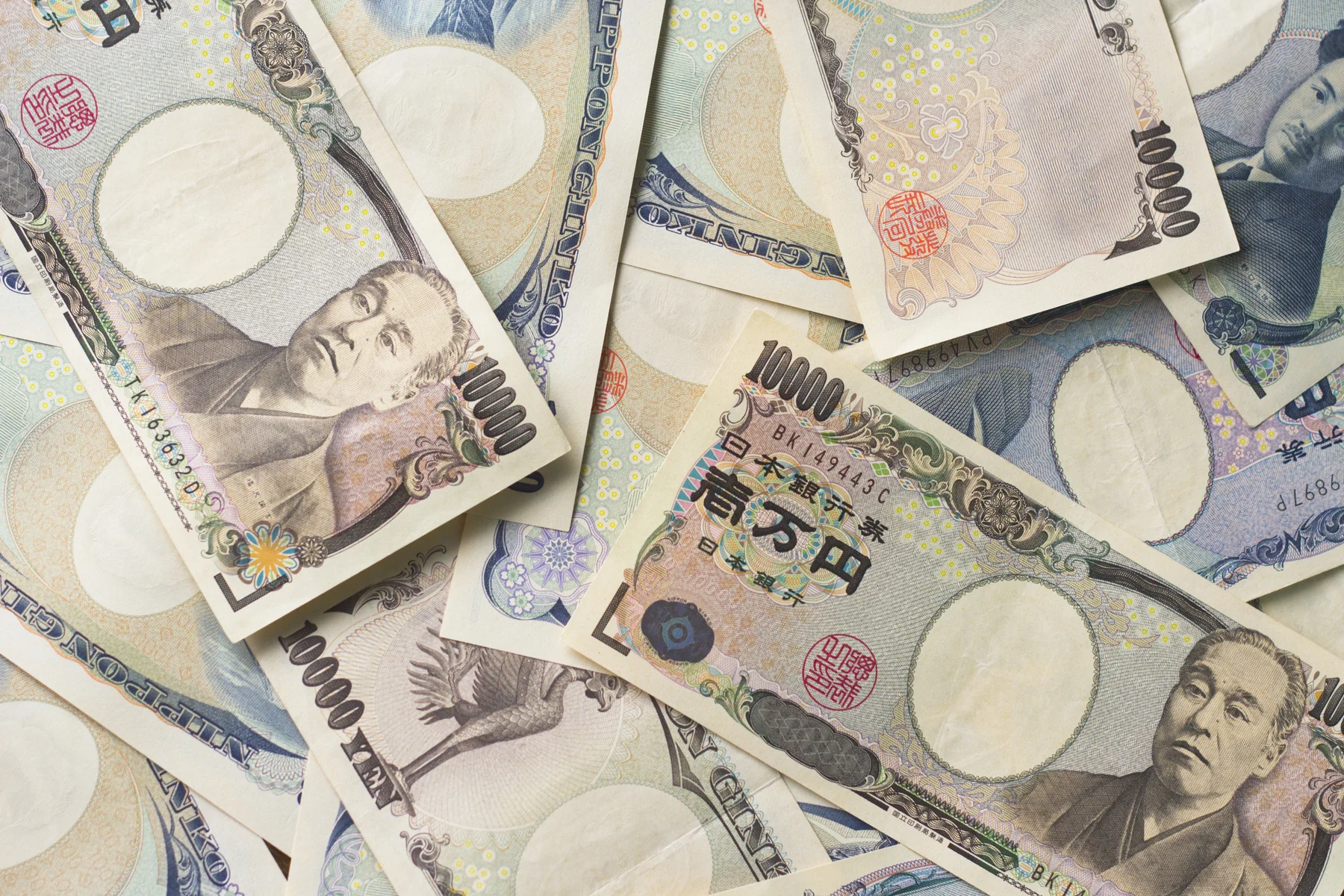
The Finance Ministry’s Nov. 9 table is the primary record: it reports ¥15,399.3 billion for July–September, with operations on July 30, July 31 and Aug. 3; the daily amounts sum to the quarter total. Reuters independently reports the ¥7.98 trillion July 30 operation as a record in the ministry’s daily series and supplies the contemporaneous exchange-rate context. The Ministry release gives amounts and currency direction but does not measure the trades’ lasting effect on the yen; this report makes no claim that the intervention secured a durable exchange-rate change. A Japan Times page did not fetch, and no unique claim from it is used. Reuters’ banknote photograph required separate licensing; the two archive images here are independently reusable and are explicitly dated context, not photographs of the intervention. Lead: Japanexperterna.se, photographed Dec. 15, 2014, CC BY-SA 3.0. Inline: Fg2, photographed Jan. 28, 2007 and released to the public domain. Original files are retained in public/newsroom/source-originals/japan-fx-intervention-20261109. The yen notes (5,184 × 3,456) were proportionally resized to 1,800 × 1,200 and converted to WebP quality 86; the Bank of Japan image (1,486 × 963) was kept at its original dimensions and converted to WebP quality 86. Metadata was removed; neither was cropped or retouched.
The new detail is the daily breakdown
Japan’s Ministry of Finance on Nov. 9 published its July–September foreign-exchange intervention table, including the amount used on each intervention day. The release lists ¥15,399.3 billion in total operations across the quarter, all on three days: July 30, July 31 and Aug. 3.
The largest entry was ¥7,975.6 billion on July 30. The ministry recorded another ¥5,552.3 billion the next day and ¥1,871.4 billion on Aug. 3. Those figures add to the quarter total. In each entry, Japan sold U.S. dollars and bought yen.
A record single-day purchase
Reuters reported the July 30 operation as the largest one-day yen purchase in the Ministry of Finance series, which dates to 1991. It exceeded the previous daily record of ¥6,278.7 billion on April 30, according to the ministry’s data.
The ministry’s release supplies the amounts and currency pairs, not a policy rationale. Reuters reported that the intervention was intended to slow the yen’s decline. At the time, the currency was near 164 per U.S. dollar, around its weakest level in four decades, Reuters said.

What intervention can change
In a yen-buying intervention, authorities sell foreign currency and buy yen in the market. That adds demand for the yen at the time of the transactions, but the disclosed amount alone cannot show how long any effect lasted or how much of a later move came from intervention rather than interest-rate expectations, trade or other market forces.
The new table provides a day-by-day official record of the summer operations. It does not announce a new intervention on Nov. 9 or a change in policy; the trades it describes happened months earlier.
A disclosure, not a new market operation
The distinction matters because the overall ¥15.4 trillion figure had already been reported in earlier ministry disclosures. Monday’s release adds the allocation among the three intervention dates, including the scale of the July 30 record day.
The numbers show how much Japan’s authorities spent buying yen during the period. They do not establish that the currency’s longer-term direction changed, and the Ministry’s table does not assess the intervention’s effectiveness.
Sources
2 references
- Japan Ministry of FinanceForeign Exchange Intervention Operations (July – September 2026)Primary quarterly table of operation dates, amounts and currency pairs; reports ¥15,399.3 billion in total. · 2026-11-09
- ReutersJapan's July yen-buying intervention sets fresh daily recordIndependent reporting on the newly released breakdown, the record one-day amount, the prior daily record and market context. · 2026-11-09