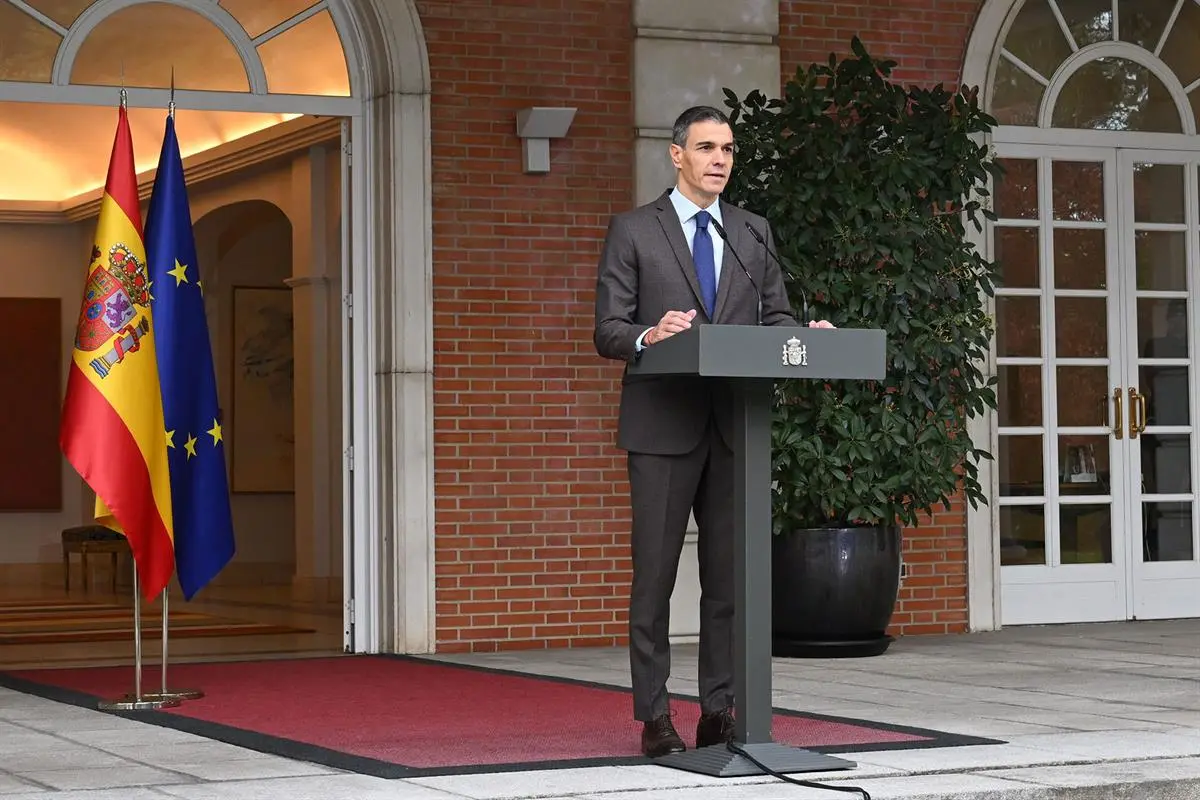
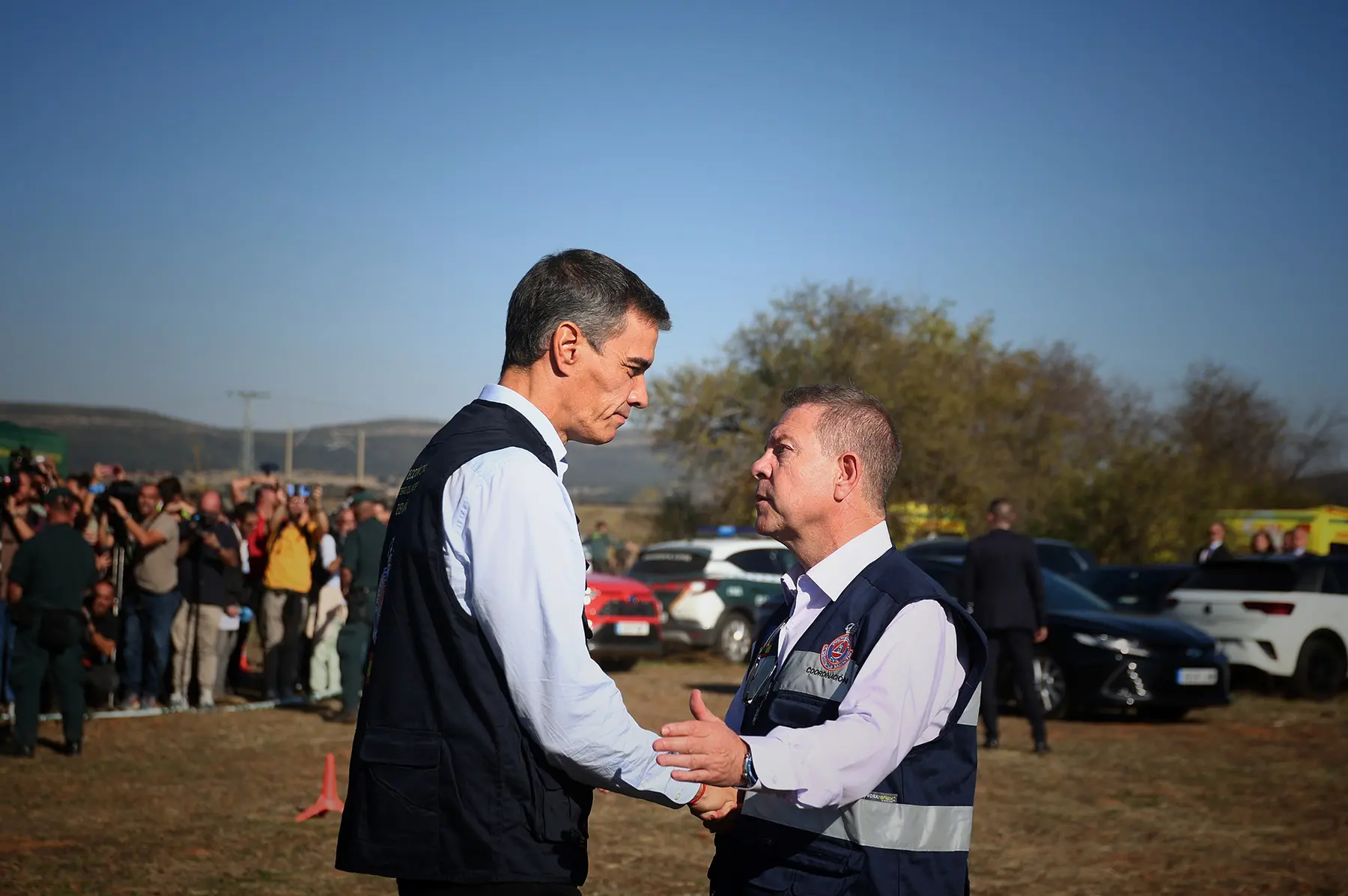
La Moncloa’s Nov. 4 statement says Deputy Prime Minister and Economy Minister Carlos Cuerpo would temporarily assume the transport portfolio until the Nov. 29 election; Reuters independently reported the handover, while AP and Reuters separately covered Óscar Puente’s resignation and the rail crashes behind it. Their reporting says the Oct. 28 Urda collision killed 69 people and a January crash on the Madrid-Seville line killed 46. This article does not treat the resignation as an admission of legal responsibility or an early account of the October crash as a final investigation finding. The lead photograph shows Prime Minister Pedro Sánchez’s Nov. 4 statement; the inline photograph records his Oct. 28 visit to the Urda emergency command post, not the collision itself. Both are credited Pool Moncloa photographs. La Moncloa’s legal notice authorizes reproduction of site content except third-party protected material, says Pool Moncloa images are freely accessible, and requires source/date attribution and no distortion. Original files are retained in public/newsroom/source-originals/spain-cuerpo-transport-appointment-2026; the lead was converted to WebP at its native 1,200 × 800 dimensions and the inline image was proportionally resized from 2,000 × 1,330 to 1,800 × 1,197 and converted to WebP at quality 84. No crop or content retouching was applied.
Cuerpo takes on the transport portfolio temporarily
Spanish Prime Minister Pedro Sánchez said on Nov. 4 that Deputy Prime Minister and Economy Minister Carlos Cuerpo would temporarily run the Transport and Sustainable Mobility Ministry after Óscar Puente resigned the previous evening. The government’s announcement says the arrangement will last through the Nov. 29 general election.
Cuerpo continues to hold the economy portfolio while taking on transport responsibilities. The announcement did not set out who would lead the ministry after the vote.
The handover follows two deadly rail crashes
Puente’s departure came a week after an Oct. 28 collision near Urda, south of Madrid, killed 69 people, according to AP and Reuters. A separate January crash on the Madrid-Seville line killed 46, AP reported. The pair of disasters has put rail safety and the government’s response under scrutiny before the election.
Sánchez’s statement framed the resignation as a gesture of respect for those affected and said the government would continue victim support and work to restore normal service on the high-speed network. That is the government’s stated rationale; the resignation itself does not establish who was legally responsible for either crash.
Safety measures remain in the new minister’s brief
Before leaving office, Puente announced service restrictions on the Madrid-Seville line pending a safety review, a 40-kilometre-per-hour limit when drivers must rely on sight after a signalling failure, more rail-control staff and a faster rollout of standardized European signalling and train-safety technology. Reuters also reported plans to improve control-centre conditions and double compulsory passenger-insurance payouts.
Those steps were announced measures to be implemented or accelerated, not reforms already completed. The official announcement of Cuerpo’s interim role did not say whether he would change them.
Sources
6 references
- La Moncloa, Presidency of the Government of SpainCarlos Cuerpo to take over as acting Minister of Transport after Óscar Puente’s resignationPrimary government announcement; states Cuerpo’s temporary remit through the Nov. 29 election. · 2026-11-04
- ReutersSpain’s deputy PM to assume transport minister’s portfolio after resignationIndependent report on the interim handover and its timing. · 2026-11-04
- The Associated PressSpain’s transport minister steps down six days after fatal high-speed rail crashIndependent reporting on Puente’s resignation, the October collision and the January crash. · 2026-11-03
- ReutersSpain’s transport minister resigns over deadly train crashIndependent report on the crash response and safety measures Puente announced; these are described as plans, not completed work. · 2026-11-03
- La Moncloa, Presidency of the Government of SpainUrda crash command-post photo gallery, 28 October 2026Primary photo source; Pool Moncloa / Sandra Armada. · 2026-10-28
- La Moncloa, Presidency of the Government of SpainLegal notice and image-reuse termsPrimary rights terms: reproduction permission, third-party-rights exception, free access for Pool Moncloa images, and source/date attribution. · 2026-11-05