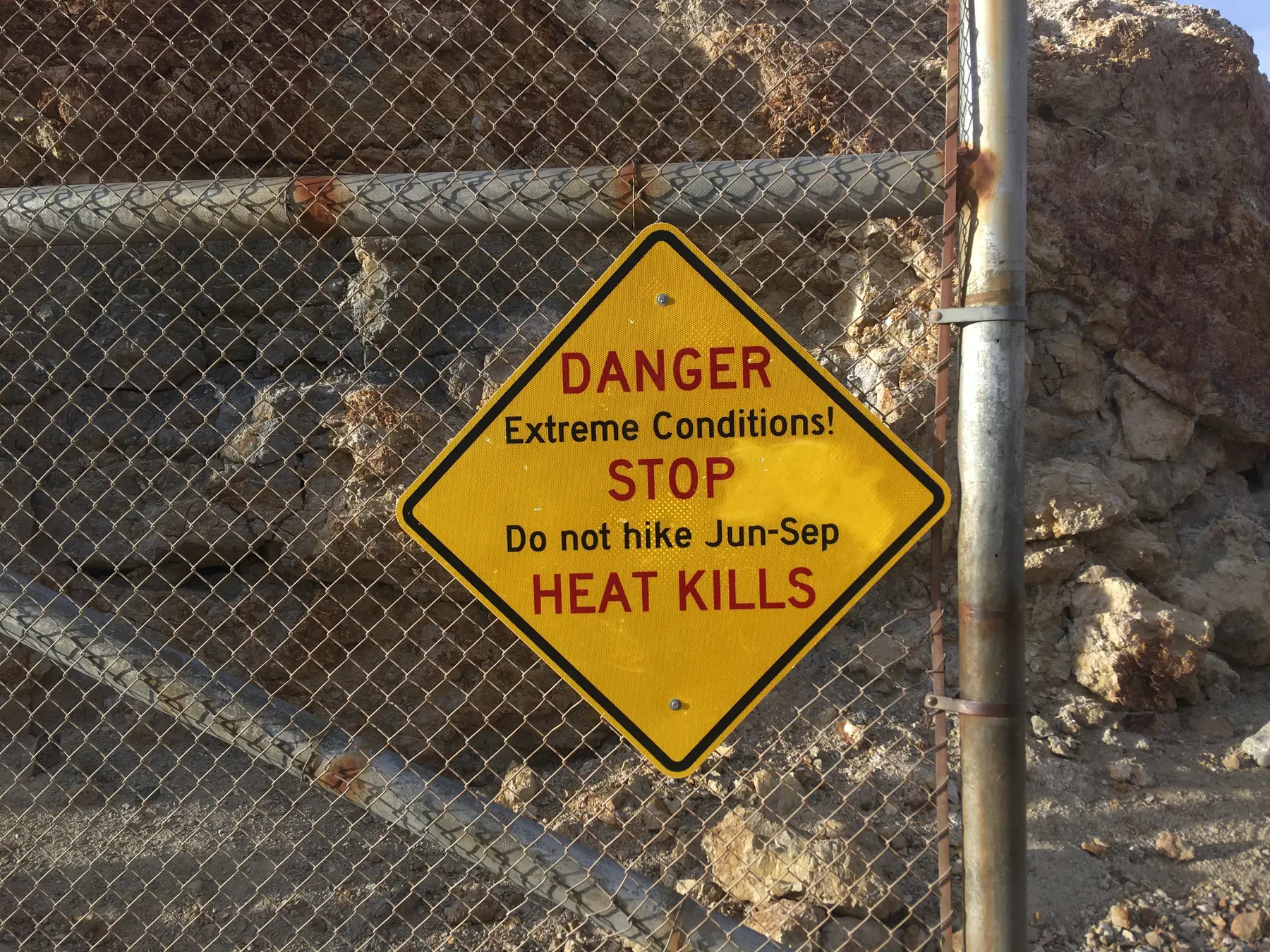
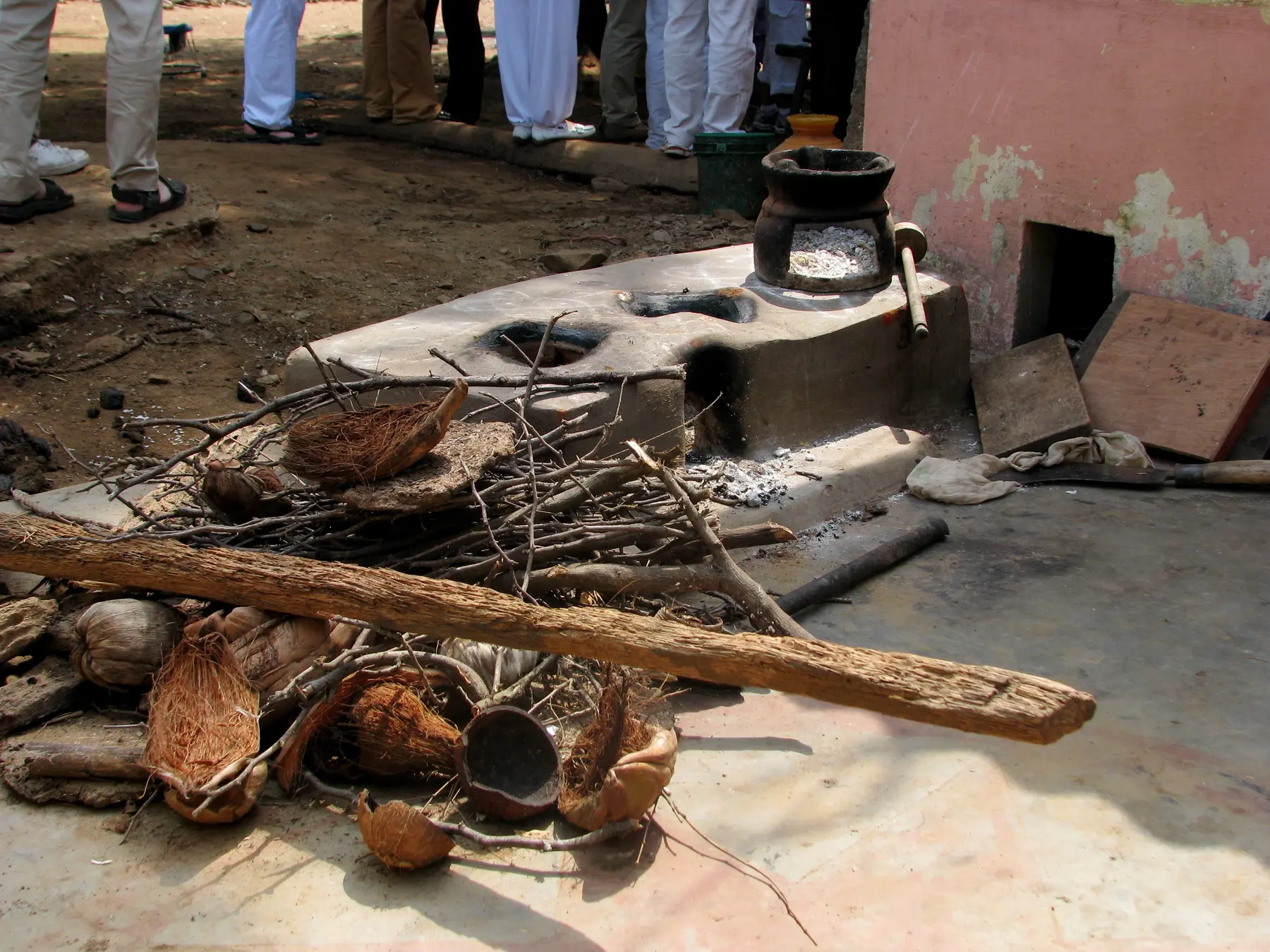
WHO’s 4 November release and 529-page technical report were checked against an independent Health Policy Watch examination. The mortality, emissions and economic figures are modelled global scale-up estimates, not observed results or a forecast that governments have adopted the measures. The 1.2 million share (75% of 1.6 million) is calculated from WHO’s published totals; Health Policy Watch reports that the fuel-pricing scenario has no implementation-cost estimate and relies on ambitious assumptions. Both photographs are contextual archive images, not scenes from the WHO report or current climate impacts. The lead image is C4K3’s heat warning sign at Lake Mead National Recreation Area, photographed 20 February 2022, licensed CC BY-SA 4.0. The inline image is mckaysavage’s traditional chulla cookstove in rural Tamil Nadu, photographed 2 February 2009, licensed CC BY 2.0. The originals are retained in public/newsroom/source-originals/climate-health-report-2026. Each was proportionally resized to 1,800 × 1,350 pixels and converted to WebP at quality 84; no crop or content retouching was applied. The first derivative retains the source’s share-alike terms.
A global scenario, not a count of lives saved
A World Health Organization model says scaling six climate-health measures worldwide could avert 1.6 million deaths each year. But about 1.2 million of those projected lives—three-quarters of the total, by calculation from WHO’s figures—are tied to changing how governments price fossil fuels.
The agency released its 529-page technical report on 4 November, ahead of the COP31 climate talks in Antalya, Türkiye. The model compares broad scale-up of the measures with a scenario in which coverage does not expand. It estimates potential annual benefits, not deaths already prevented or a prediction that countries will enact the policies.
The six measures are heat-health warning systems; climate-resilient drinking water; basic sanitation; hygiene and handwashing facilities; cleaner fuels and technologies for cooking and heating; and more efficient fossil-fuel pricing. WHO estimates the package could avoid 16.7 billion tonnes of carbon-dioxide-equivalent emissions a year and generate $3.9 trillion in annual economic-welfare benefits, alongside $5.4 trillion in fiscal benefits.
The largest gains come with a difficult price change
WHO attributes 1.2 million of the projected annual deaths averted to efficient fossil-fuel pricing, including removing inefficient subsidies and taxing fuels to reflect harms such as air pollution and climate damage. That estimate dominates the headline total. The other five measures together account for roughly 360,000 deaths a year in the report’s calculations.
For those five interventions, WHO estimates $24 in benefits for every dollar invested. Health Policy Watch’s review puts their annual cost at about $35 billion. The pricing-policy scenario is different: the report does not provide an implementation-cost estimate for it, so the $24 ratio should not be read as a return covering the entire six-action package.
The policy could also raise household energy and transport costs unless governments design support for people affected by a transition. That distributional question matters because fuel subsidies often lower prices directly, while the health and climate gains arrive across society.
Ambitious assumptions shape the totals
The report models the period from 2024 to 2075 and describes its scale-up pathways as aspirational. Health Policy Watch says the fossil-fuel scenario assumes comprehensive pricing reform in 168 countries from 2024, and universal access to safe water, sanitation and clean cooking by 2030. The outlet also notes that the fuel-pricing estimate draws on older underlying data and that the report does not cost the reform itself.
The $3.9 trillion figure is a monetised estimate of health, environmental and economic welfare, not equivalent to government revenue or money available in a budget. WHO lists fiscal benefits separately; Health Policy Watch notes the welfare figure is gross and does not subtract implementation costs. The report itself flags limited evidence in some areas, uncertain long-term projections and modelling that does not capture every interaction between measures.
COP31 is scheduled to open in Antalya on 9 November. The WHO analysis offers governments a set of quantified scenarios to debate, but turning them into outcomes would depend on financing, delivery capacity and decisions about who bears the cost of energy-price reform.
Sources
3 references
- World Health OrganizationGlobal benefits and costs of prioritized actions on climate change and health: technical reportPrimary 529-page report describing modelled scale-up scenarios, the six interventions, benefit estimates and limitations. · 2026-11-04
- World Health OrganizationSix climate and health actions could save 1.6 million lives and deliver trillions in benefits each yearPrimary announcement of the projected mortality, emissions and economic and fiscal benefits. · 2026-11-04
- Health Policy WatchWHO’s Trillion-Dollar Climate-Health Case Rests On Taxing Fossil FuelsIndependent review of the report’s fuel-pricing assumptions, cost coverage and distinction between gross welfare benefits and implementation costs. · 2026-11-05