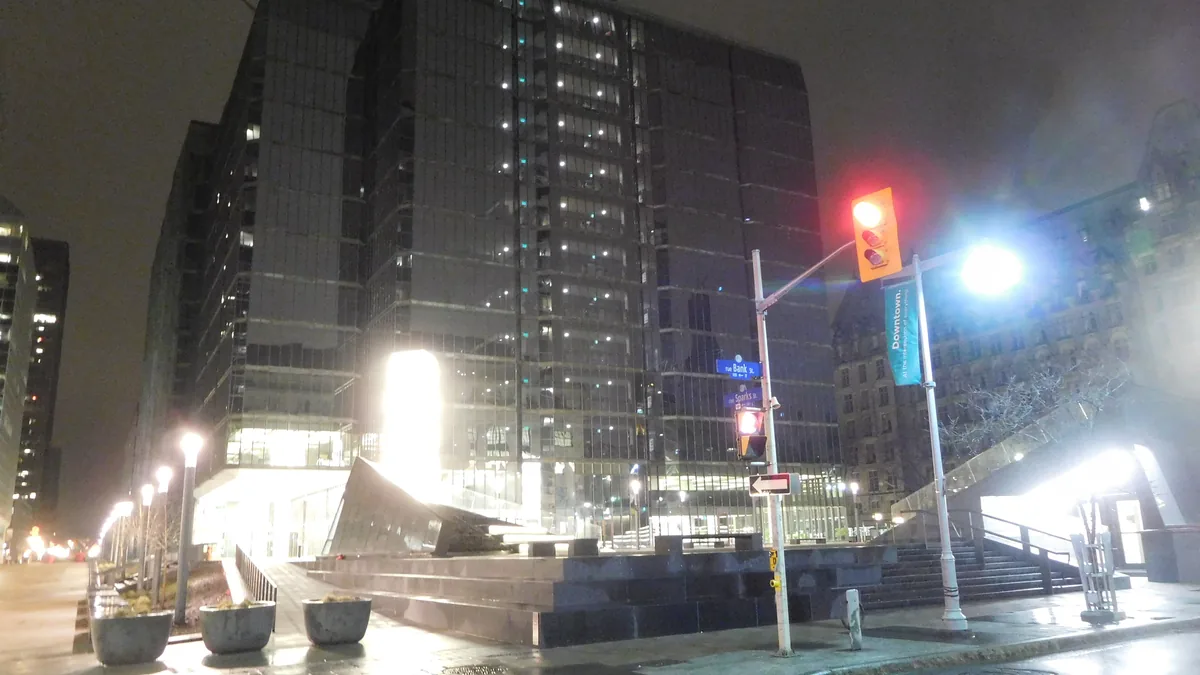
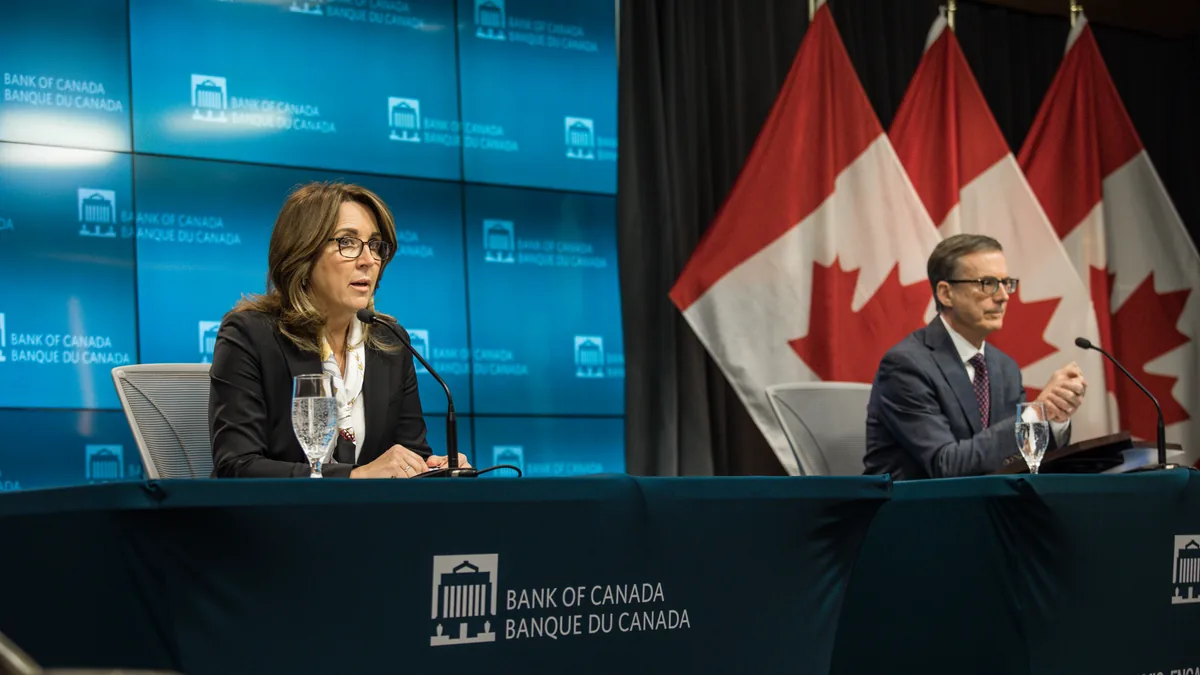
The policy options, reasons for the decision, inflation and growth forecasts, and guidance on future meetings were checked against the Bank of Canada's Nov. 10 summary of deliberations and its Oct. 28 rate statement and opening statement. Reuters independently reported the minutes' release, described the move as the first increase in more than three years and noted criticism that the decision was premature. The summary records a consensus decision after discussion of two options; it does not publish individual votes, so this article does not characterize the council as split. No calculation assumes that every mortgage or loan rate moves one-for-one with the policy rate. A bounded current-event image search found Bank press materials and news-agency photographs but no clearly reusable photo of the October meeting. The lead is a 2017 Bank of Canada building photograph by Jeangagnon, CC BY-SA 4.0. The inline image is a Jan. 26, 2022 Bank press conference with Carolyn Rogers and Tiff Macklem, published by the Bank under CC BY 2.0. Both are archive context. Originals are retained in source; derivatives were centre-cropped to 1,200 × 675 and converted to WebP at quality 82 with no retouching.
Council weighed a hold against the first increase in three years
The Bank of Canada's Governing Council considered leaving its policy rate at 2.25% or raising it by a quarter point before settling on 2.5%, according to the deliberation summary released Tuesday. It was the first increase since July 2023.
The case for holding rested on inflation still being concentrated in energy and energy-intensive services. Inflation excluding gasoline was 2.2% in September, core measures were close to 2%, and the economy still had spare capacity. New US tariffs were also expected to slow Canadian growth in the fourth quarter.
Officials feared fuel costs would spread through supply chains
The argument for an increase was forward-looking. Gasoline, diesel and heating oil were substantially more expensive than in July, and the Bank expected those prices to stay high. Businesses had largely absorbed the resulting input costs, but surveys and past experience suggested more of those costs would reach consumers over the following year.
Officials also pointed to higher prices for non-energy imports, including chemicals, plastics, rubber, semiconductors and computer components. They judged that stronger-than-expected activity would absorb slack faster, leaving less economic weakness to offset those pressures. The Bank projected inflation at 3.5% at the end of 2026 and above 3% through much of 2027 before returning to 2% around mid-2028.
Further increases remain possible, but each meeting stands alone
Council members agreed that monetary policy cannot reduce global energy prices. Their aim is to stop an energy shock from changing wage and price-setting behaviour across the economy. Near-term inflation expectations had risen, while longer-term expectations remained anchored.
The summary says another increase could be needed, but it gives no preset path. Future decisions will depend on the duration of the Middle East-driven energy shock, Canada-US trade tensions, financial conditions and the speed with which business costs reach retail prices. A higher policy rate can influence mortgages and other borrowing costs, but the timing and size depend on each product and lender rather than moving every household payment automatically by a quarter point.
Sources
6 references
- Bank of CanadaSummary of Governing Council deliberations: Fixed announcement date of October 28, 2026Primary record of the policy debate and decision. · 2026-11-10
- Bank of CanadaBank of Canada raises the policy rate by 25 basis points to 2½%Primary rate decision and economic projections. · 2026-10-28
- Bank of CanadaMonetary Policy Report Press Conference Opening StatementPrimary explanation of the first increase since July 2023. · 2026-10-28
- ReutersBank of Canada felt uncertainty over rates did not mean inaction, minutes showIndependent reporting on the minutes and reaction to the decision. · 2026-11-10
- Wikimedia CommonsBank of Canada Building - 01.jpgArchive location photograph by Jeangagnon, licensed CC BY-SA 4.0. · 2017-04-15
- Wikimedia CommonsGovernor Tiff Macklem and Senior Deputy Governor Carolyn Rogers (51845374500).jpgArchive Bank of Canada press-conference photograph, licensed CC BY 2.0. · 2022-01-26








