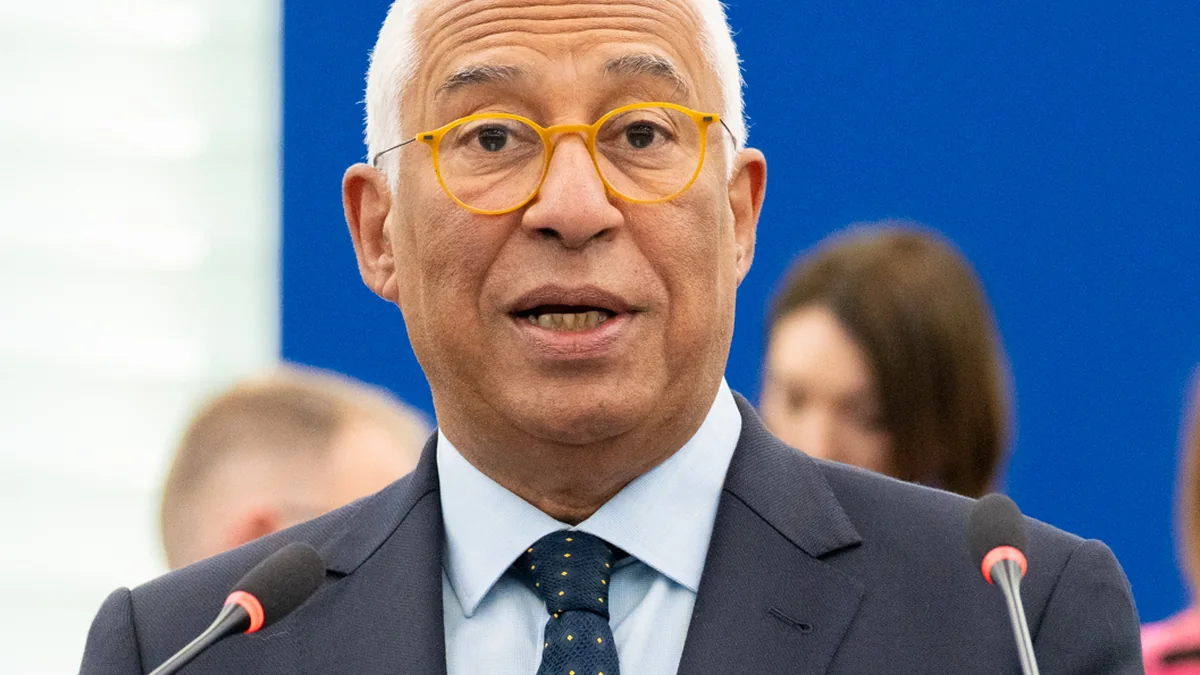
INCE NEWS compared European Council President António Costa’s published proposal and Council timeline with Reuters reporting on reactions from France, Germany and the European Parliament. The €1.582 trillion total and €180.6 billion reduction from the Commission plan use constant 2025 prices in Reuters’ comparison; Costa’s document describes a €204 billion, or 10%, reduction in current prices. Those figures are not interchangeable. The plan is a negotiating proposal, not an adopted budget: all 27 member states must agree unanimously and the European Parliament must consent. No reusable photograph of the November 21 presentation was identified in a bounded search; the story therefore uses a dated 2025 portrait of Costa and a separate 2024 photograph of the Europa building. Both are archive context and neither depicts the proposal’s presentation.
A smaller offer shifts money toward security and growth
European Council President António Costa has proposed a €1.582 trillion European Union budget for 2028–2034, cutting back the European Commission’s opening bid while directing a larger share toward defence, competitiveness and border management.
Reuters calculated that the plan is €180.6 billion below the Commission proposal in constant 2025 prices and €40 billion below an Irish compromise circulated in October. Costa’s own document uses current prices and describes a €204 billion, or 10%, reduction. The two comparisons reflect different price bases.
The proposal would still raise EU spending on competitiveness by 120% and defence by 232% compared with the current seven-year budget. Migration and border funding would double, Horizon Europe research funding would rise 57%, and Erasmus funding would increase 25%, according to Costa’s published outline.
The compromise protects farms and regions but not enough for France
Costa’s plan shields agriculture and regional cohesion more than several other programmes. That choice reflects pressure from governments that opposed moving large national allocations into a more flexible central fund.
France nevertheless called the offer very disappointing, saying it did not sufficiently protect farmers. Germany took the opposite fiscal position and said the overall budget remained too high, while the European Parliament’s lead negotiator rejected the scale and distribution of the cuts.
Those objections expose the core trade-off: every euro restored to farm or regional spending either expands the total bill, requires higher national payments or comes from newer priorities such as industrial policy, defence and external action.

New EU-wide revenues remain politically sensitive
Costa proposes five revenue streams intended to raise about €60 billion a year: levies tied to digital services, the carbon border adjustment mechanism, electronic waste, tobacco and the emissions trading system.
The digital-services levy is especially contentious because it would fall heavily on large US technology companies. It could become entangled with trade relations even as governments seek revenue that does not come directly from national budgets.
Average national contributions would rise only slightly, from 0.80% to 0.82% of gross national income, under Costa’s presentation. The proposal also leaves room to slow repayment of more than €600 billion in joint borrowing raised for the post-pandemic recovery fund, an option that could ease near-term pressure while extending liabilities.
Unanimity makes the November summit a test, not a finish line
EU leaders will meet at a special European Council on November 26 and 27. Costa’s document is the basis for that negotiation, but it is not an agreement and cannot take effect on his authority.
The seven-year budget requires unanimous approval from all 27 member states and consent from the European Parliament. A single government can block the package, while lawmakers can refuse a settlement they consider too small or poorly balanced.
The summit will therefore test whether leaders can narrow disputes over the total, farm protection and new revenue. Even a political breakthrough would still require detailed legal texts and parliamentary approval before the next budget period begins in 2028.
Sources
7 references
- European CouncilMultiannual financial framework: President Costa’s proposalPrimary proposal setting out spending priorities, national contributions, revenue streams and the current-price comparison with the Commission plan. · 2026-11-21
- Council of the European UnionTimeline: EU long-term budget 2028–2034Primary timeline confirming presentation of the revised proposal and the November 26–27 special European Council. · 2026-11-21
- Council of the European UnionEuropean Council conclusions — draft negotiating box for the 2028–2034 MFFPrimary negotiating text detailing the proposed budget structure and conditions. · 2026-11-21
- ReutersEU leaders’ chair proposes new cuts to 2028–2034 budgetIndependent reporting on the constant-price total, allocation changes, member-state divisions and parliamentary response. · 2026-11-21
- ReutersLatest EU budget proposal is very disappointing, French presidency saysIndependent confirmation of France’s objection over agricultural funding. · 2026-11-21
- Wikimedia CommonsAntónio Costa, 2025.jpgLead-photo provenance and CC BY 2.0 licence; European Parliament source requires visible credit. · 2025-04-01
- Wikimedia CommonsEuropa building 2024.jpgInline-photo provenance and CC BY-SA 4.0 licence. · 2024-08-11