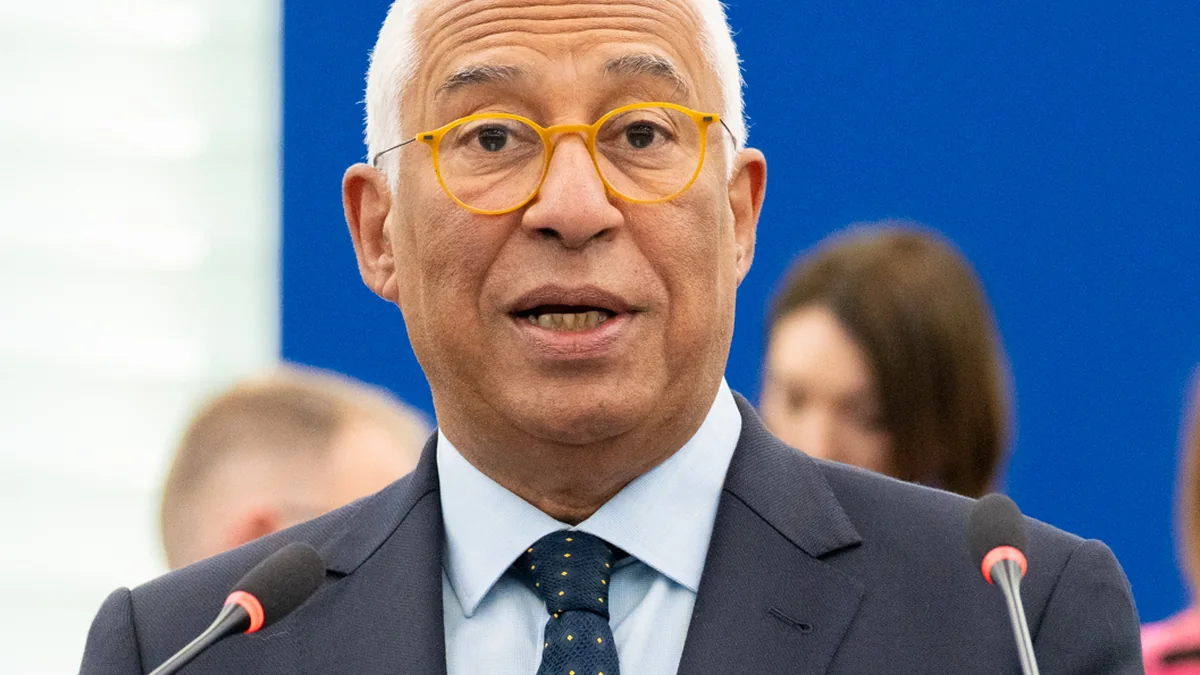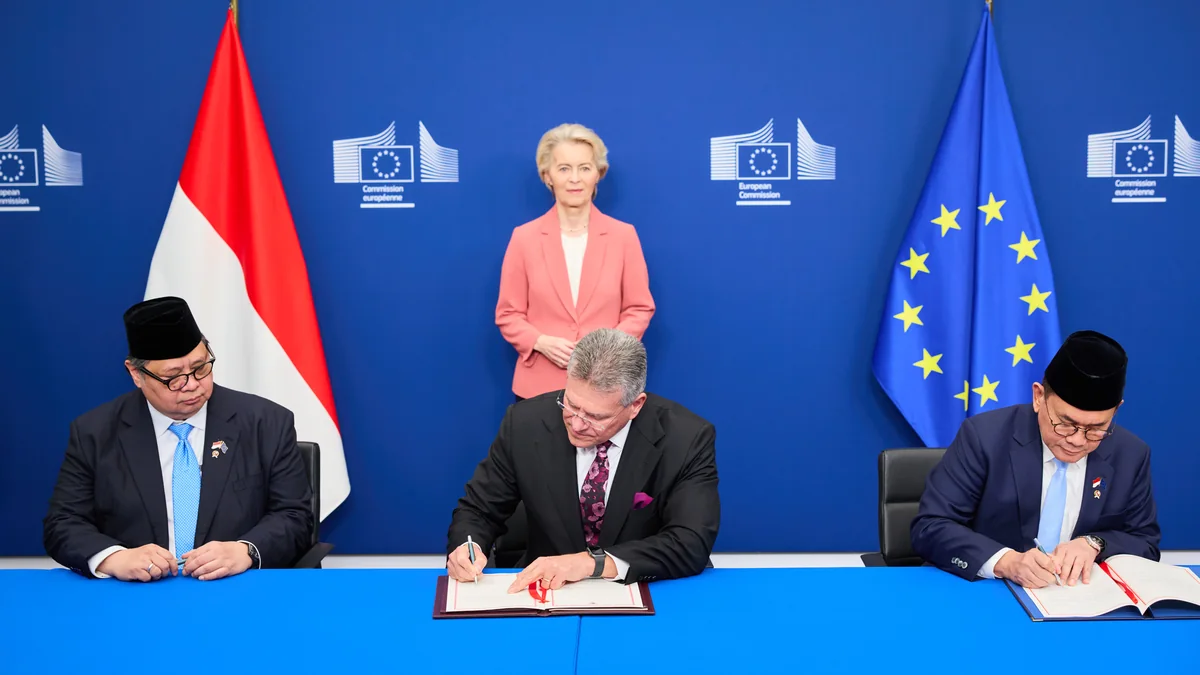
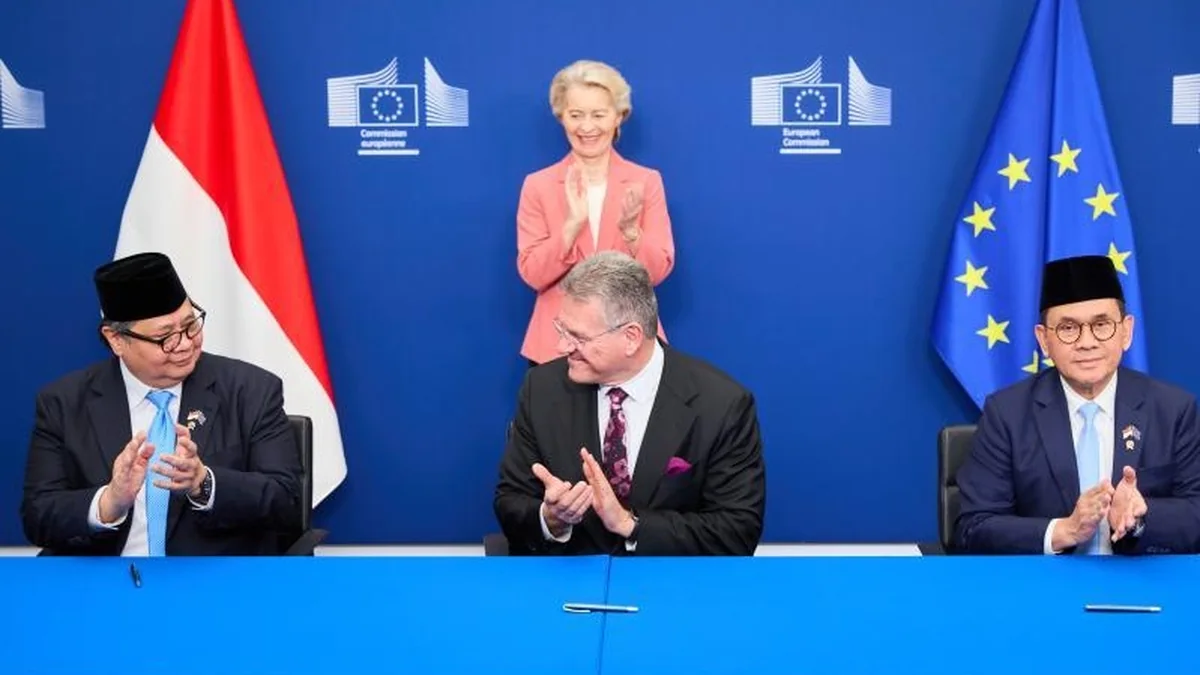
INCE NEWS checked the European Commission's signed-agreement announcement, trade factsheet and country page against the Council's authorisation and Reuters reporting. Signature on November 21 was a completed diplomatic act; tariff reductions and investment rules are not yet in force. Provisional application requires the EU and Indonesia to complete and notify their internal procedures, while formal EU conclusion also requires European Parliament consent and a Council decision. Savings and export increases are official projections, not realised results. The two photographs are same-day images from the European Commission Audiovisual Service, photographed by Dati Bendo. The EU owns the files and licenses them under CC BY 4.0 subject to the portal's stated restrictions; both show public officials at the official signing. The lead uses the 4,000 × 2,667 original. The inline source rendition was 799 × 533 and was enlarged for the site's standard frame.
Signature ends the negotiations, not the legal process
The European Union and Indonesia signed a comprehensive trade agreement and a separate investment-protection agreement in Brussels on Saturday, closing negotiations that began in July 2016 and setting up one of the EU's largest commercial openings in Southeast Asia.
The ceremony creates no immediate tariff entitlement. Provisional application can start only after both sides complete and notify the internal procedures required by their legal systems. Full EU conclusion also needs the European Parliament's consent and a later Council decision.
Officials have targeted early 2027 for provisional application, partly because Indonesia is due to leave the EU's Generalised Scheme of Preferences on January 1. That timetable is an objective rather than a guaranteed effective date.
Tariff cuts would cover almost all goods
The Comprehensive Economic Partnership Agreement would eventually liberalise up to 98.5% of tariff lines. The Council says 96% of Indonesian tariffs would disappear within five years, including duties of up to 50% on EU-made vehicles.
European officials estimate the changes would save businesses about €600 million a year in customs duties. EU agricultural exporters would gain wider access and protection for 221 geographical indications, while rice, sugar and ethanol remain outside full liberalisation and other sensitive products face quotas.
Indonesia would receive improved access for products including textiles, footwear and agricultural goods. The Commission projects EU exports to Indonesia could rise by almost 40% within 15 years and Indonesian goods and services exports to the EU by more than 14%. Those figures model a future agreement and are not measured gains.
Investment and raw materials sit beside market access
The investment agreement sets protections against unlawful expropriation and discriminatory treatment while restating governments' right to regulate for public health, climate and environmental objectives. It creates mediation and state-to-state mechanisms and a work programme for a future investor dispute system.
The trade agreement also covers services, public procurement, digital commerce, intellectual property, energy and raw materials. For the EU, those chapters form part of an effort to diversify supply chains and reduce exposure to trade disruptions.
For Indonesia, the opportunity is to turn wider market access into manufacturing investment and higher domestic value. That outcome depends on company decisions, implementation rules and whether the agreement's sustainability requirements can be enforced in practice.
Palm oil and sustainability remain the test
Palm oil has long complicated EU-Indonesia trade. The agreement includes climate, environmental and labour commitments and treats the Paris Agreement as an essential element, but it does not erase separate EU product standards or deforestation rules.
That distinction matters for exporters: lower tariffs do not automatically prove that a shipment meets environmental, safety or traceability requirements. Each side will still apply its domestic rules, subject to the agreement's disciplines and dispute procedures.
The next concrete milestones are parliamentary consent, completion of Indonesia's domestic process and mutual notification for provisional application. Until then, the signed texts are a political and legal commitment awaiting operational effect.
Sources
7 references
- European CommissionEU and Indonesia sign ambitious trade and investment agreementsPrimary announcement confirming signature and setting out projected trade effects and next steps. · 2026-11-21
- European CommissionEU trade relations with IndonesiaPrimary country page confirming the agreements, negotiation timeline and existing trade framework. · 2026-11-21
- European CommissionEU-Indonesia CEPA: main benefitsPrimary factsheet on market access, sustainability commitments and projected sector effects. · 2026-11-21
- Council of the European UnionCouncil greenlights signature of landmark trade and investment agreementsPrimary decision and legal roadmap for provisional application, Parliament consent and full entry into force. · 2026-11-18
- Reuters via EuronextEU and Indonesia sign trade deal after 10 years of negotiationsIndependent reporting on the signing, expected timing and key tariff provisions. · 2026-11-21
- European Commission Audiovisual ServiceSigning ceremony of the EU-Indonesia trade and investment agreementsOfficial same-day photo report identifying the event, participants, photographer and media IDs. · 2026-11-21
- European Commission Audiovisual ServiceCopyright and conditions of useOfficial reuse terms stating that EU-owned audiovisual content is licensed under CC BY 4.0 unless otherwise indicated, with stated third-party and personality-right restrictions. · 2026-11-22