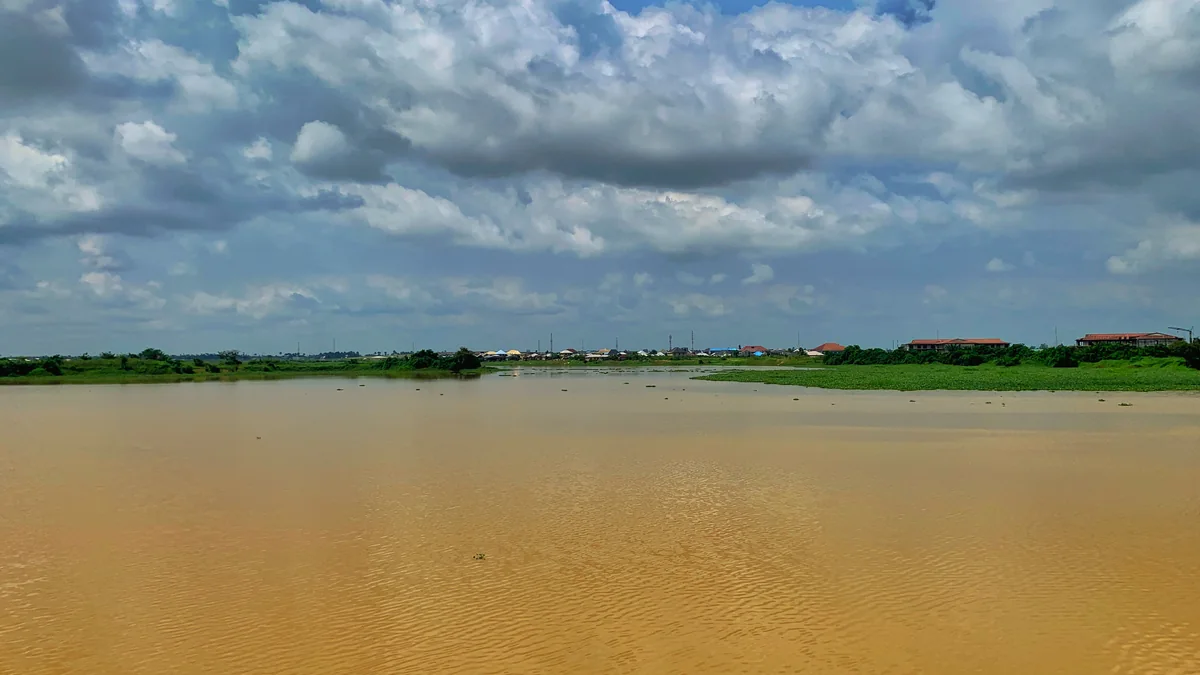
INCE NEWS compared the National Emergency Management Agency’s Saturday update, as reproduced by Nigerian reporting, with Associated Press, Reuters and the Bayelsa police account published by Punch. NEMA’s latest confirmed toll was 24 bodies recovered; police separately reported 24 survivors. Authorities had not published a passenger manifest or a total aboard, so this article does not repeat unverified community estimates as fact or calculate a missing-person total. The reported mechanical fault, the operator’s alleged refusal to turn toward shore and his reported flight are preliminary police claims, not findings of liability. Same-day photographs from AP and news publishers, and official response photographs from NEMA, lacked clear reuse terms. Two dated CC BY-SA 4.0 archive-context photographs are used instead: a 2023 passenger boat in Oporoma, the community whose police division coordinated the response, and a 2021 river view near Yenagoa. Neither depicts the November 20 capsize.
The confirmed toll rose while the search continued
At least 24 people died after a passenger boat carrying mourners to a funeral capsized in Nigeria’s southern Bayelsa State, turning a routine river journey into one of the country’s deadliest transport disasters this year.
The vessel was travelling from Ayama to Ukubie on Friday when it overturned at the river junction between Oweikorogha and Otuan communities in Southern Ijaw Local Government Area. Nigeria’s National Emergency Management Agency said on Saturday that 24 bodies had been recovered and search operations were continuing.
Bayelsa police said 24 people were rescued. Nineteen were taken to Ayama Clinic and five injured passengers to a hospital in Yenagoa, while other survivors reportedly returned to their communities.
No public manifest means the scale is still incomplete
Authorities had not said how many people were aboard or how many remained unaccounted for. Without a passenger manifest, the confirmed deaths and rescues cannot be turned into a reliable total for the vessel.
Community accounts cited much larger passenger estimates, but those figures had not been verified by NEMA or police. The responsible description is therefore at least 24 dead, not a final toll.
The uncertainty has practical consequences for families and rescuers. It complicates the task of determining who was on the journey, whether everyone has been found and when the recovery operation can move to a complete accounting.
Police describe a mechanical fault, but liability is unresolved
Police said preliminary information indicated that the boat developed a mechanical problem. Passengers allegedly asked the operator to head toward shore, but he declined before the vessel capsized, according to the police account reported by AP and Punch.
The operator was reported to have fled, while the boat’s manager was taken into custody. Those details form part of an early investigation; they do not establish the cause of the sinking or legal responsibility.
Marine police, local divers, NEMA, the state emergency agency, the Red Cross and civil-defence personnel joined the response. Difficult river terrain continued to slow the work.
The disaster exposes a recurring river-safety gap
For many communities across the Niger Delta, boats are essential public transport rather than an optional excursion. That dependence makes vessel maintenance, passenger limits and life jackets basic safety infrastructure.
Bayelsa’s information commissioner urged operators and passengers to stop overloading, speeding and travel without life jackets. Police issued a similar warning while the investigation remained open.
Nigeria has recorded repeated mass-casualty boat accidents on inland waterways. The immediate priority in Bayelsa is finding everyone who was aboard; the longer-term test is whether enforcement changes before another crowded journey ends the same way.
Sources
6 references
- National Emergency Management Agency via TheStar Nigeria24 rescued, many missing in Bayelsa boat mishapPrimary-agency statement reproduced by local reporting, confirming 24 bodies recovered, 24 survivors and the multi-agency search. · 2026-11-22
- Associated PressAt least 24 dead in Nigeria when boat capsizes while carrying people to a funeralIndependent reporting on the toll, rescue operation, preliminary police account and state safety response. · 2026-11-21
- ReutersDeath toll from Nigeria boat accident rises to 24Independent confirmation of NEMA’s revised death toll. · 2026-11-22
- Punch NigeriaFour dead, 24 rescued in Bayelsa boat accident – PoliceLocal reporting reproducing the first Bayelsa police statement, survivor destinations and preliminary mechanical-fault account. · 2026-11-20
- Wikimedia CommonsPassenger Boat, Oporoma Community, Bayelsa State.jpgLead-photo provenance and CC BY-SA 4.0 licence. · 2023-07-04
- Wikimedia CommonsRiver in Yenagoa, Bayelsa State.jpgInline-photo provenance and CC BY-SA 4.0 licence. · 2021-11-24