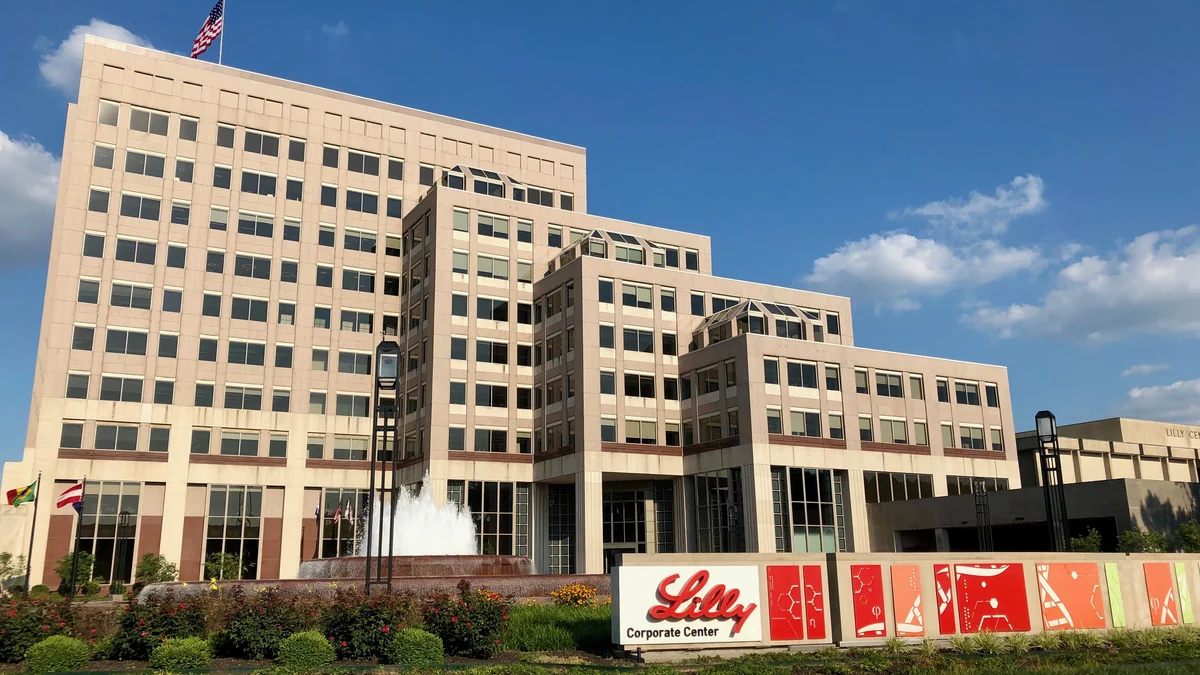
Reuters' full Nov. 12 report was reviewed for the Chinese approval, first-in-market status, competitor landscape, launch uncertainty and market estimates. Lilly China's approval announcement, distributed by PR Newswire Asia, supplies the approved adult indication, confirms that the type 2 diabetes indication remains under NMPA review, and identifies the Chinese product name and supporting trial programme. The peer-reviewed ATTAIN-1 abstract indexed by PubMed was checked for trial design, participant count, weight-change results and discontinuations; it was funded by Lilly and is evidence about efficacy and safety, not market access or comparative superiority. No Chinese prescribing information or public NMPA assessment report was available in an accessible English form, so the article does not specify dose, contraindications, price, reimbursement or launch date. Reuters' actual-event image is licensed commercially and Lilly's promotional imagery did not establish independent republication rights. Two dated archive/context photographs are used instead: Lilly's Indianapolis corporate centre in 2019 and unidentified white pills in 2009. Neither shows orforglipron, its Chinese packaging or a Chinese clinic. Originals are retained; derivatives were centre-cropped to 16:9, resized to 1,200 × 675 and converted to WebP quality 86 without retouching.
The approval creates a new oral option in China
China’s medicines regulator has approved Eli Lilly’s once-daily orforglipron for long-term weight management in adults with obesity, or adults who are overweight and have at least one weight-related condition. Lilly says the medicine will be sold in China as Muyouda.
Reuters reported that it is the first oral GLP-1 medicine approved in China for weight management. Existing products in the class have been injectable. GLP-1 receptor agonists imitate the action of a gut hormone involved in appetite and blood-sugar regulation; orforglipron is a small-molecule, nonpeptide pill rather than an injectable peptide drug.
Approval does not answer price or access
Lilly said it was preparing a commercial launch through authorised healthcare and pharmaceutical institutions, but it did not disclose a Chinese price or availability date. Approval therefore permits marketing for the stated indication; it does not mean patients can immediately obtain the medicine everywhere or that it will be reimbursed.
The separate application for type 2 diabetes remains under review, according to Lilly China. The obesity approval should not be read as approval for that additional indication, and treatment decisions depend on the final Chinese prescribing information and clinical assessment.
The pivotal trial showed weight loss and gastrointestinal effects
The 72-week ATTAIN-1 trial randomly assigned 3,127 adults with obesity and without diabetes to daily orforglipron at three doses or placebo, alongside diet and physical activity. In the intention-to-treat analysis, average weight changed by 7.5%, 8.4% and 11.2% at the three doses, compared with 2.1% for placebo.
The peer-reviewed report said gastrointestinal effects were the most common adverse events and were mostly mild to moderate. Treatment discontinuation because of adverse events ranged from 5.3% to 10.3% in the orforglipron groups, compared with 2.7% for placebo. The trial was funded by Lilly, and its results do not substitute for individual medical advice.
Competition will test convenience against efficacy and cost
Orforglipron enters a market that already includes weekly injections from Lilly, Novo Nordisk, Pfizer and China’s Innovent Biologics. Novo’s application for oral Wegovy was accepted by Chinese regulators in August but had not been approved at publication; domestic manufacturers are also developing oral GLP-1 candidates.
Reuters cited an analyst estimate that annual Chinese sales of GLP-1 weight-management medicines could rise from roughly 3 billion–4 billion yuan now to 30 billion yuan within five to seven years. That is a forecast, not a guaranteed market size. Pricing, insurance coverage, prescribing restrictions, generic competition and real-world tolerability will determine how much of the projected demand becomes treatment access.
Sources
5 references
- ReutersEli Lilly becomes first drugmaker to have a GLP-1 weight-loss pill approved in ChinaIndependent reporting on the approval, launch uncertainty, competitors and Chinese market outlook. · 2026-11-12
- Lilly China / PR Newswire AsiaChina’s first oral GLP-1 medicine for weight management, Muyouda (orforglipron), approvedCompany announcement confirming the approved indication and the status of the separate diabetes application. · 2026-11-12
- New England Journal of Medicine / PubMedOrforglipron, an Oral Small-Molecule GLP-1 Receptor Agonist for Obesity TreatmentPeer-reviewed ATTAIN-1 phase 3 trial abstract reporting weight change and adverse-event discontinuations; funded by Lilly. · 2025-11-06
- Wikimedia CommonsEli Lilly Corporate Center, Indianapolis, Indiana, USA.jpgArchive photograph by Momoneymoproblemz, licensed CC BY-SA 4.0. · 2019-08-01
- Wikimedia CommonsPills.JPGArchive photograph by Ayena, released into the public domain by the creator. · 2009-04-11








