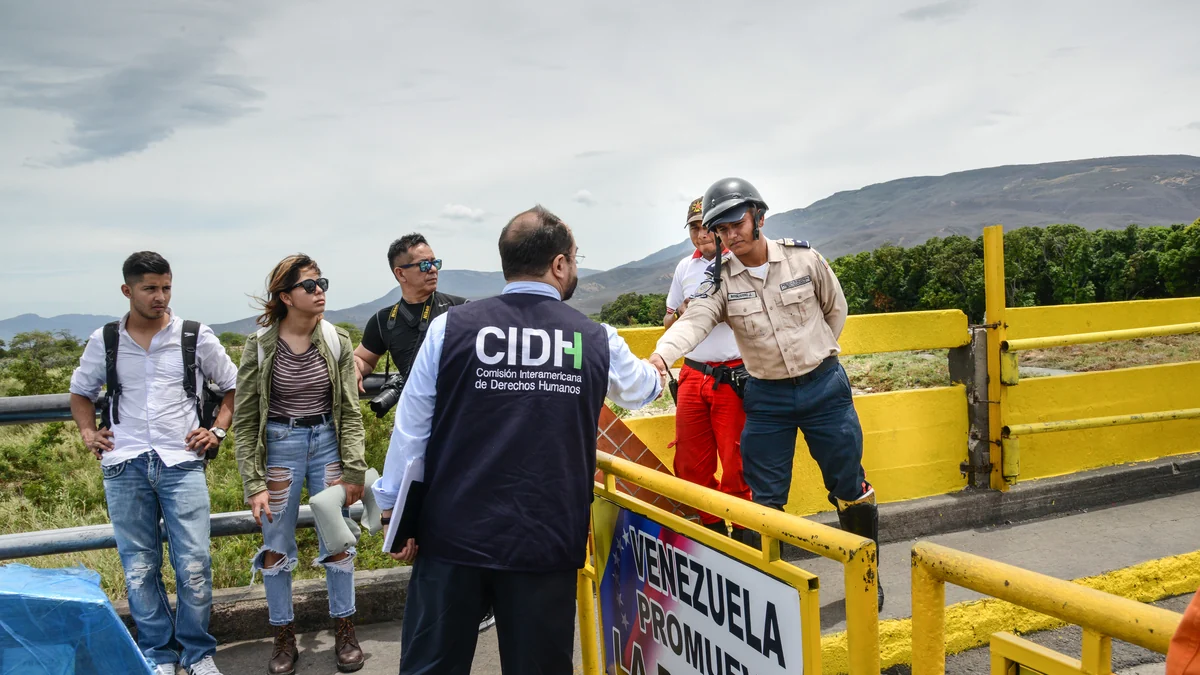
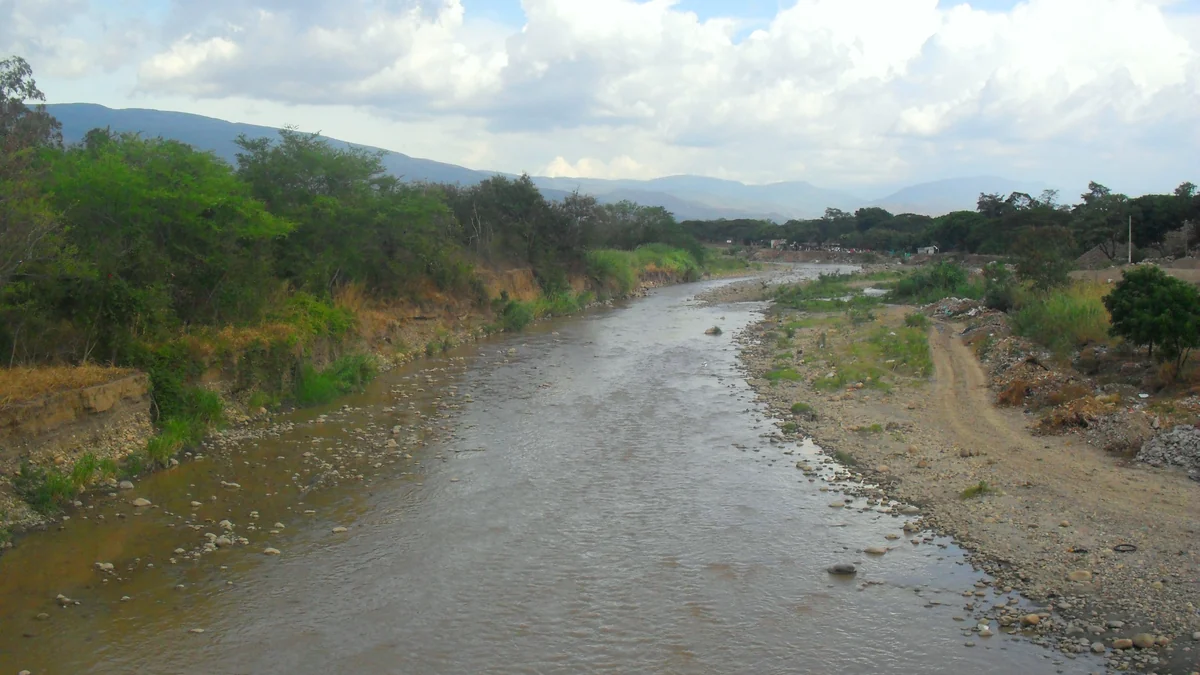
Colombia’s Nov. 12 foreign-ministry statement was read directly for the contact between the two foreign ministers and Venezuela’s offer of assistance in the search for Nancy Gómez. Reuters independently reported both governments’ willingness to coordinate and the two kidnapping cases. EFE and Caracol Radio were checked for the Venezuelan statement, the deployment in Apure and the status of army officer María Camila Pantoja; neither the deployment nor the new channel proves that either captive crossed into Venezuela or that the searches have produced a result. Colombia attributes the officer’s abduction to the ELN, which acknowledged holding her; responsibility for Gómez’s abduction remains an official suspicion. Current-event images located in official and commercial coverage did not carry clear republication rights. The article therefore uses two dated archive context photographs: a 2015 Inter-American Commission on Human Rights visit to the Simón Bolívar bridge under CC BY 2.0 and a 2013 view of the Táchira River boundary under CC BY-SA 4.0. Neither depicts the November 2026 searches. Originals are retained; derivatives were centre-cropped to 16:9, resized to 1,200 × 675 and converted to WebP quality 86 without retouching.
A kidnapping near Uribia triggered direct ministerial contact
Colombia and Venezuela opened a high-level security channel on Thursday after two kidnappings exposed how armed groups exploit their 2,219-kilometre frontier. The immediate test is whether diplomatic contact can turn into usable intelligence before captives are moved deeper into remote border territory.
Colombian Foreign Minister Omar Bula Escobar spoke with Venezuelan counterpart Oliver Blanco to coordinate the search for Nancy Gómez, the wife of Uribia Mayor Jaime Luis Buitrago. Gómez was abducted in Colombia on Nov. 11. Bogotá says the captors may have crossed into Venezuela, but that movement has not been independently confirmed.
A second case broadens the search beyond La Guajira
The governments are also under pressure over Second Lieutenant María Camila Pantoja, who was seized in Saravena, Arauca, on Nov. 4. Colombia attributes that abduction to the National Liberation Army, known as the ELN; the group acknowledged the following day that it was holding her.
The two cases sit far apart along the frontier. Uribia is in northern La Guajira, while Saravena faces Venezuela’s Apure state hundreds of kilometres to the south-east. That geography makes a single rescue operation unlikely and increases the value of local intelligence, river patrols and fast information exchange.
Venezuela offered coordination and deployed forces in Apure
Venezuela’s foreign ministry said existing bilateral channels were available for information sharing and whatever security coordination proved necessary. Separately, Venezuela’s armed forces announced patrols in Apure aimed at camps, illicit airstrips, extortion, drug trafficking and smuggling.
The deployment may help restrict armed movement, but Venezuelan authorities did not say it was a rescue mission or confirm that either captive was in the country. Colombia’s account of the suspected border crossing and its allegation against the ELN therefore remain distinct from what Caracas has publicly established.
Cooperation will be measured by recoveries, not statements
The ELN and other armed groups have long used river corridors, informal crossings and weak state presence along the frontier. Relations between Bogotá and Caracas have also shifted repeatedly, limiting sustained joint operations and allowing disputes over sanctuary and responsibility to outlast individual crises.
The new channel lowers one immediate obstacle by giving investigators a direct route to request checks and share leads. Its practical value will depend on whether authorities can locate Gómez and Pantoja, secure their release and identify the networks that moved them — outcomes neither government had reported by publication time.
Sources
6 references
- Colombia Ministry of Foreign AffairsHigh-level dialogue with Venezuela activated to coordinate actions for Nancy Gómez’s rescuePrimary statement on the foreign-minister call, Colombian working hypothesis and Venezuelan offer of cooperation. · 2026-11-12
- ReutersVenezuela, Colombia to collaborate on border security following kidnappingsIndependent reporting on the two cases, bilateral positions and the 2,219-kilometre frontier. · 2026-11-12
- EFEVenezuela deploys troops on Colombia border after army officer’s kidnappingIndependent reporting on the Apure deployment and the officer’s abduction. · 2026-11-12
- Caracol RadioVenezuela expresses willingness to coordinate security actions with ColombiaRegional reporting quoting the Venezuelan foreign-ministry statement and its limits. · 2026-11-12
- Wikimedia CommonsMembers of CIDH at the Colombia-Venezuela borderArchive context photograph by the Inter-American Commission on Human Rights, CC BY 2.0. · 2015-09-10
- Wikimedia CommonsRío Táchira, frontera Colombia - VenezuelaArchive context photograph by EEIM, CC BY-SA 4.0. · 2013-08-09








