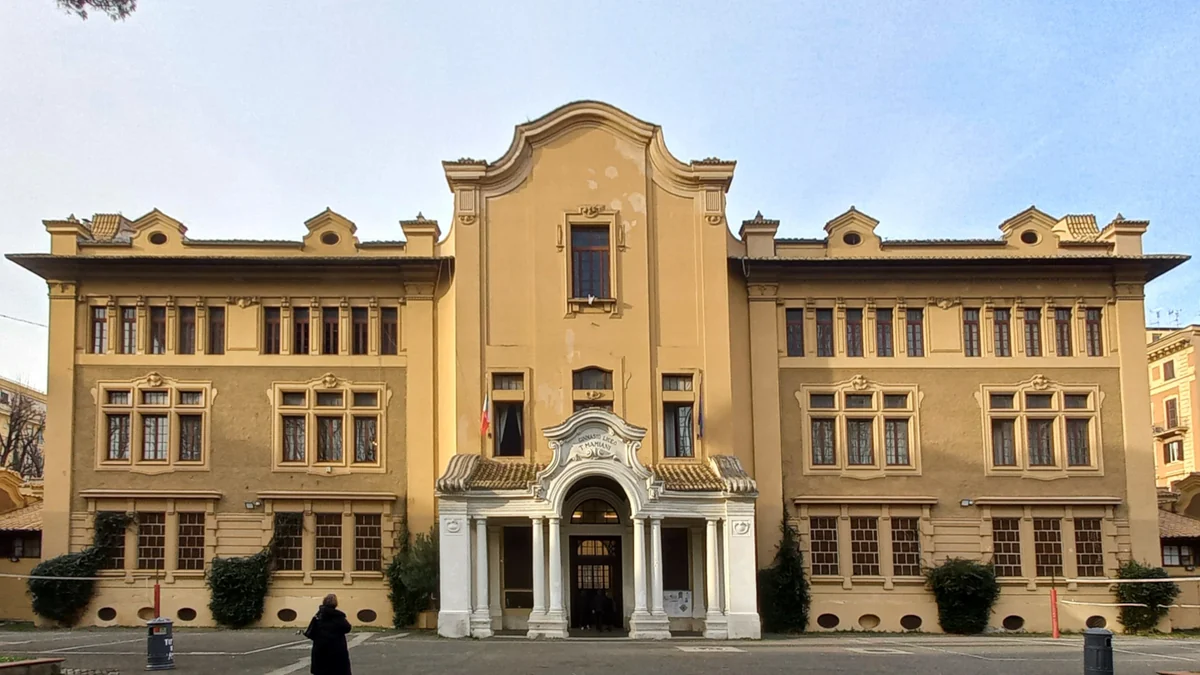
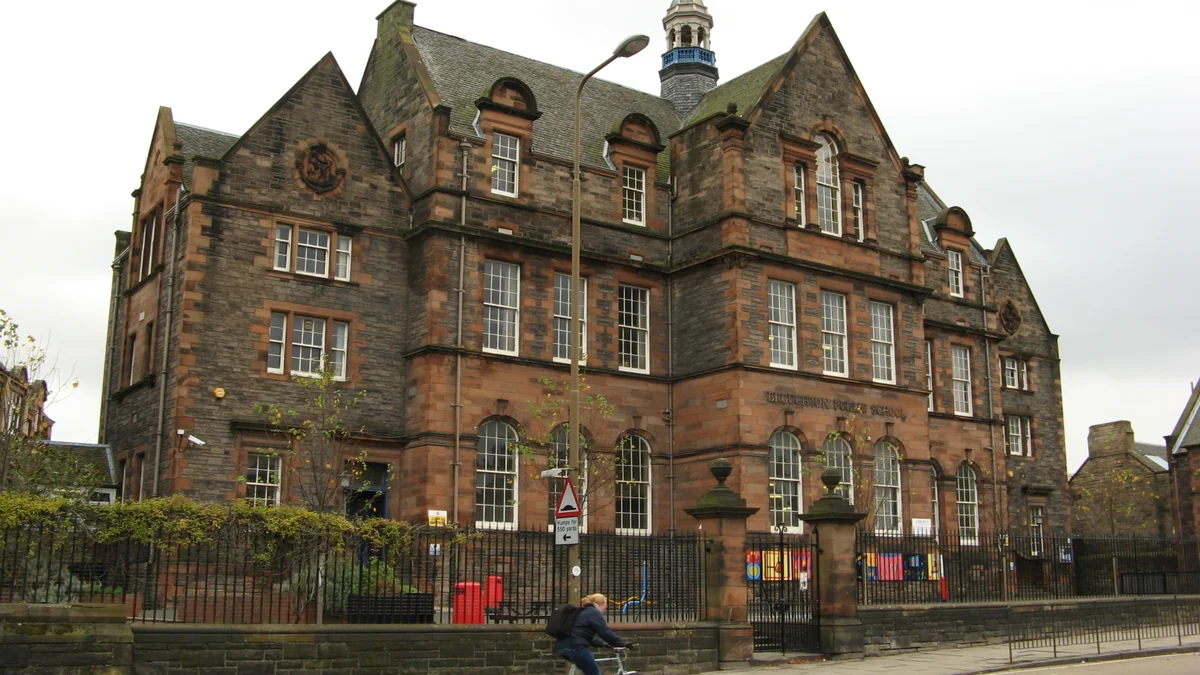
Reuters’ Nov. 12 report was reviewed for Italy’s second-wave count, the revised evacuation guidance and the government’s response. AP and ANSA independently reported the first wave, official school counts and the absence of concrete danger. Police Scotland’s statements were checked directly for its assessment, approximate national reach and continuing cyber investigation. Counts refer to schools that received messages, not confirmed devices or evacuations, and reporting systems differ across countries. No evidence reviewed established the sender’s identity or a state sponsor; the article does not repeat attribution speculation as fact. Current event photographs from agencies lacked reusable rights. Two dated CC BY-SA archive/context photographs are used: Rome’s Liceo Mamiani, one of the schools evacuated in the first wave, photographed in 2024, and Broughton Primary School in Edinburgh in 2007. Neither shows the November 2026 response. Originals are retained; derivatives were centre-cropped to 16:9, resized to 1,200 × 675 and converted to WebP quality 86 without retouching.
A second Italian wave met a different response
About 3,700 Italian schools received hoax bomb warnings on Thursday, Reuters reported, one day after messages reached roughly 6,300 schools and prompted hundreds of evacuations. The second wave produced far less disruption because most schools stayed open.
Prime Minister Giorgia Meloni’s government told schools and other public buildings not to evacuate automatically after a mass email. Clearance would generally be reserved for cases with concrete indications of danger, while police continued checks and central authorities coordinated the response.
The policy shift tries to deny anonymous senders their main effect
Wednesday’s evacuations moved pupils into streets, forced parents to leave work and interrupted lessons even though searches found no explosive devices. The harm came from fear and operational disruption rather than a physical attack.
Keeping schools open reduces that leverage, but it also moves more responsibility onto threat assessment. Staff still have to report messages, follow emergency protocols and react to suspicious activity; the guidance does not treat every warning as harmless.
Similar messages crossed borders
Police Scotland said around a thousand Scottish schools received a threatening email that had circulated widely across the United Kingdom and Northern Ireland. The force assessed it as non-credible and said there was no wider threat to the public, while its Cyber and Fraud Unit worked with domestic and international partners to identify the source.
More than 300 schools in Northern Ireland and schools in the Republic of Ireland also received generic messages, according to authorities cited in independent reporting. Local advice differed on precautionary evacuation, but police assessments converged on a hoax rather than a verified bomb threat.
No verified attribution has emerged
The messages used an invented-sounding signature and appeared amid other disruptive threats against European institutions. Officials and commentators raised the possibility of hybrid warfare, but they also warned that copycats and attention-seekers can exploit public email lists with little technical sophistication.
No evidence reviewed for this article identifies the sender or links the campaign to Russia, Iran or another state. The confirmed development is a cross-border mass-email disruption and a shift in Italy’s response—not the identity or motive of whoever sent it.
Sources
6 references
- ReutersItalian schools defy new wave of bomb threats to remain openIndependent reporting on the second email wave, revised Italian guidance and school operations. · 2026-11-12
- Associated PressItaly’s Meloni says cyberthreats are intended to spread fear after schools hit by bomb threatIndependent reporting on the first wave, government checks and disruption. · 2026-11-11
- Police ScotlandStatement after threatening messages sent to a number of schools in ScotlandPrimary assessment that the messages were not credible and remained under cyber investigation. · 2026-11-11
- ANSAGovernment tells schools not to evacuate after more hoax bomb threatsItalian reporting on the updated national advice and the second-wave total. · 2026-11-12
- Wikimedia CommonsRoma Liceo Mamiani fronte 2024.jpgArchive photograph by Sergio D’Afflitto (Blackcat), licensed CC BY-SA 4.0. · 2024-02-16
- Wikimedia CommonsBroughton Primary.jpgArchive photograph by Jonathan Oldenbuck, licensed CC BY-SA 4.0. · 2007-10-30








