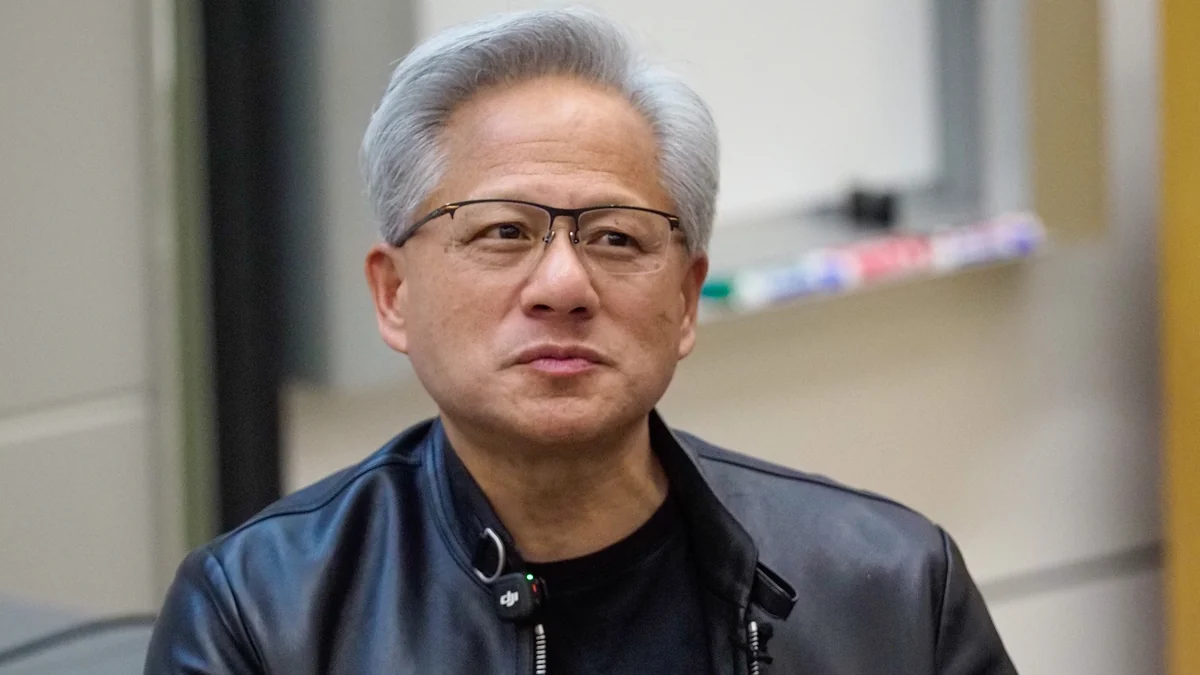
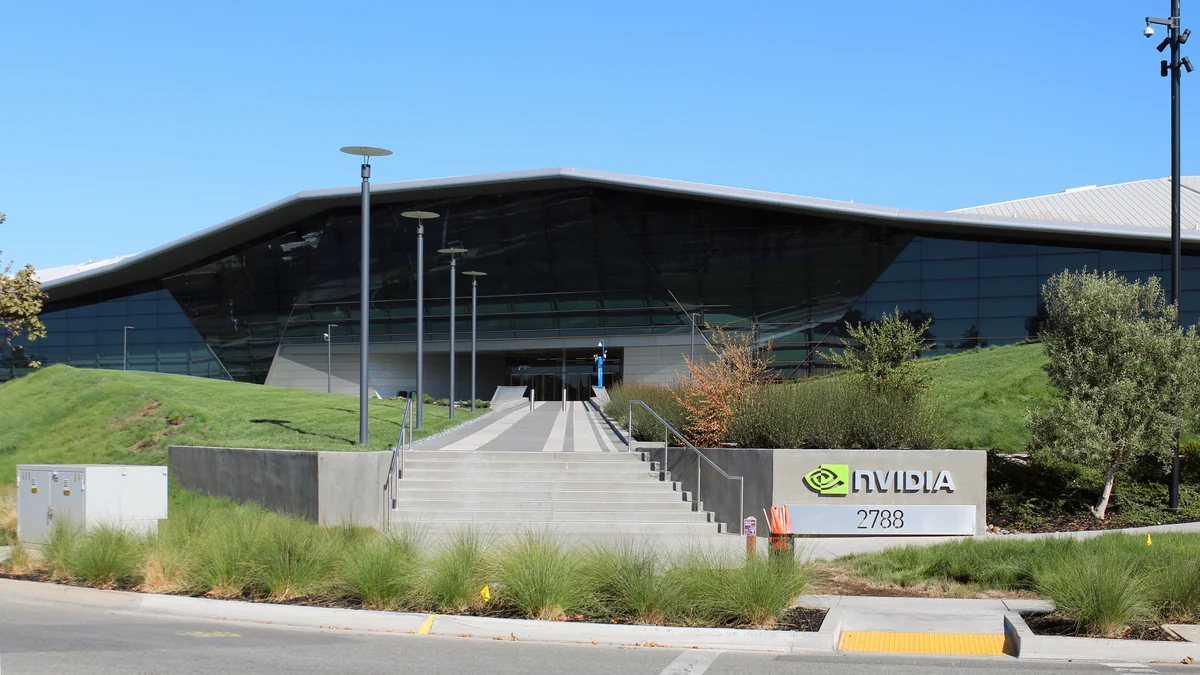
Huang’s immediate resignation, Kress’s interim appointment, Harvey Jones’s new chair role and the continuing CEO search were checked against Nvidia’s Nov. 12 announcement. Nvidia’s Nov. 8 and Nov. 10 statements establish the scope and outside leadership of the still-open independent investigation. Reuters independently confirmed the transition and reported the premarket share move and wider AI-sector consequences; AP was used for the allegation timeline and China’s denial. The article does not present the foreign-intelligence allegation as proven and notes Nvidia’s statement that it has no reason to believe company secrets or national security were compromised. A bounded current-event search found Reuters, AP, AFP/Getty and publisher photographs whose licences require separate commercial permission. The lead is Anders Eidesvik’s April 30, 2026 Stanford photograph of Huang, CC BY-SA 4.0. The inline image is Coolcaesar’s Aug. 4, 2018 photograph of Nvidia’s Santa Clara headquarters, CC BY-SA 4.0. Both are archive context. Originals are retained; derivatives were centre-cropped to 1,200 × 675 and converted to WebP at quality 86 without retouching.
An immediate exit puts the finance chief in charge
Nvidia founder Jensen Huang resigned as president, chief executive and a director on Thursday, ending a 33-year run in which he turned a graphics-chip maker into the central supplier of the artificial-intelligence boom. The departure took effect immediately.
The board appointed Chief Financial Officer Colette Kress as interim CEO while she retains her finance role. Kress joined Nvidia in 2013 after senior finance positions at Cisco and Microsoft. The company has begun a search covering internal and external candidates, so her appointment is a bridge rather than a decision on permanent leadership.
The board has separated oversight from day-to-day control
Director Harvey C. Jones became Nvidia’s first chair of the board. That creates a clearer division between oversight and management during the search, after Huang had combined extraordinary influence over strategy, products, investors and government relationships.
Nvidia said customer commitments, operations and its product roadmap should continue without interruption. The near-term technology plan is already visible, but execution now depends on a broader leadership team coordinating chip design, manufacturing partners, cloud customers and software developers without the founder who served as the company’s chief public advocate.
An unresolved investigation follows Huang out of the boardroom
The resignation follows Nvidia’s Nov. 8 decision to open an independent inquiry after reports that Huang had been targeted by a foreign-intelligence effort. Independent directors retained former acting U.S. attorney Joon H. Kim and the law firm Wachtell, Lipton, Rosen & Katz to conduct the review.
The underlying allegation involves Alice Huang, a Chinese business executive whom U.S. authorities reportedly suspected of gathering information for Beijing. China has rejected the accusation. Nvidia said when it opened the inquiry that it had no reason to believe national security or company secrets had been compromised. Those points remain allegations and company assessments, not findings from a completed investigation.
Investors are repricing a company built around one leader
Nvidia shares fell more than 10% in premarket trading after the transition was announced, Reuters reported. Earlier moves had already spread to Nvidia-backed cloud companies and other chip suppliers, while rivals AMD and Broadcom gained as investors considered whether a leadership vacuum could redistribute opportunities across the sector. Premarket prices can change sharply once regular trading begins, but the direction of the response shows how closely investors tied Nvidia’s valuation to Huang.
The company is due to report quarterly results on Nov. 17. That call will give Kress her first scheduled opportunity to explain whether spending plans, customer financing and the product timetable have changed. The harder question—who can replace the founder’s technical authority, political access and salesmanship—will remain open until the board names a permanent successor.
Sources
8 references
- NvidiaNVIDIA Announces CEO TransitionPrimary announcement of Huang’s resignation, interim leadership and permanent search. · 2026-11-12
- NvidiaStatement from NVIDIA Board of DirectorsPrimary statement defining the independent investigation and the company’s assessment of possible compromise. · 2026-11-08
- NvidiaStatement From the Independent Members of the NVIDIA BoardPrimary confirmation that former acting U.S. attorney Joon H. Kim and Wachtell were retained for the inquiry. · 2026-11-10
- ReutersNvidia CEO Jensen Huang steps down in big blow to AI boomIndependent reporting on the resignation, succession risk and premarket reaction. · 2026-11-12
- ReutersGlobal AI stocks sink as Nvidia crisis deepens sector selloffIndependent market reporting on the wider move across chipmakers and Nvidia-backed cloud companies. · 2026-11-12
- Associated PressWhat we know — and what we don’t — as Nvidia investigates an alleged spy plot involving its CEOIndependent background on the unresolved allegations, denials and export-control implications. · 2026-11-10
- Wikimedia CommonsJensen huang stanford 2026-04-30 007.jpgArchive photograph by Anders Eidesvik, CC BY-SA 4.0. · 2026-04-30
- Wikimedia CommonsNVIDIA Headquarters.jpgArchive photograph by Coolcaesar, CC BY-SA 4.0. · 2018-08-04