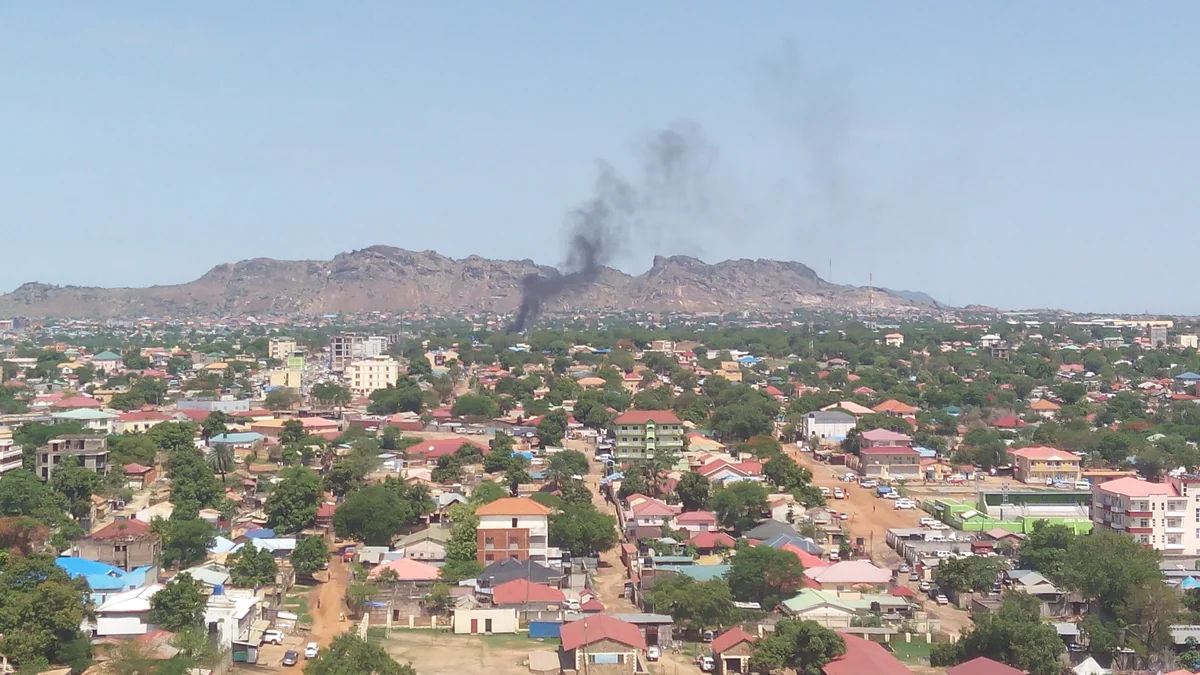
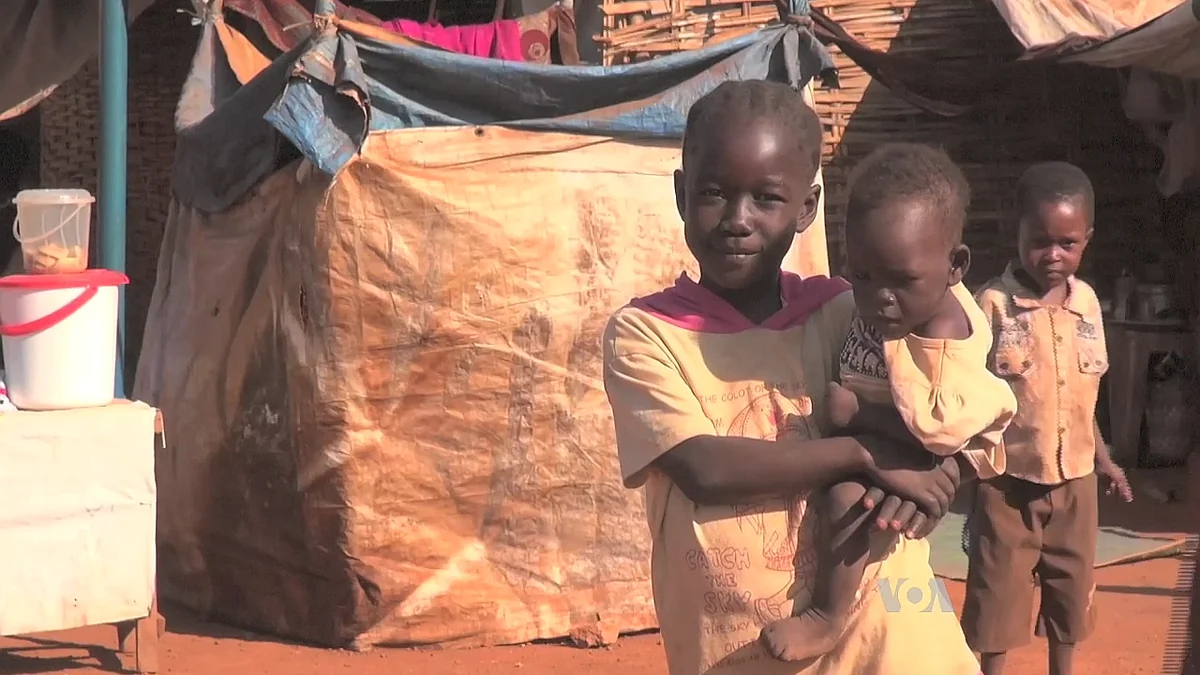
The Dec. 22 election date and commission mandate were checked against South Sudan’s National Elections Commission. The African Union’s September declaration was used for the outstanding political, legal, financial, operational and security conditions. Associated Press independently reported the Nov. 10 UN Security Council briefing, competing positions on whether the vote should proceed, Riek Machar’s status and gaps in party registration. The UNMISS release returned 403 on direct retrieval; one accessible official-source alternative was attempted, then the article relied on the AP account and accessible AU and NEC primary material. The death toll from the 2013–18 civil war is presented as AP’s approximate figure. A bounded current-event photo search found AP, UN and publisher images without a clear commercial reuse right. The lead is an April 29, 2016 Juba panorama by Rigan123, CC BY-SA 4.0. The inline image is a Dec. 8, 2016 VOA photograph by Jill Craig of displaced children at a Wau church camp, public domain in the United States and marked free of known restrictions by Wikimedia. Both are archive context and do not depict the 2026 election preparations. Originals are retained in source; derivatives were centre-cropped to 1,200 × 675 and converted to WebP at quality 86 with no retouching.
Envoys say the vote could deepen the crisis it is meant to resolve
South Sudan is scheduled to hold its first national election since independence on Dec. 22, but African Union and United Nations envoys warned the Security Council that a flawed or violent process could push the country into a larger political and security crisis.
The vote is supposed to close a transition built around the 2018 peace agreement. That accord ended a five-year civil war in which about 400,000 people were killed, according to Associated Press. The election therefore carries two competing expectations: it could give citizens their first direct choice of national leaders, or it could become the point at which an already weakened power-sharing settlement breaks down.
The legal date is fixed while the practical timetable remains uncertain
The National Elections Commission says elections should be held on Dec. 22 under the amended transitional constitution and the 2018 agreement. Its mandate covers voter registration, nominations, staff recruitment, dispute resolution and voter education.
AP reported that the commission had not announced when parties could begin registering for the election and had not answered questions about whether preparations could be completed in time. President Salva Kiir’s Sudan People’s Liberation Movement has held nationwide primaries, while other parties have shown little electoral activity. That imbalance raises doubts about whether formal polling alone would amount to an inclusive contest.
Machar’s detention narrows the path to an inclusive ballot
Kiir dissolved the transitional government in September, removed deputies and installed a caretaker administration. His longtime rival Riek Machar remains under house arrest and is on trial on charges including treason over an attack on a military garrison. Machar’s allies deny the allegations, and his party says his release is a condition for taking part in political dialogue.
The African Union has urged the parties to uphold the permanent ceasefire, avoid unilateral measures that weaken the peace agreement and agree on an electoral roadmap covering legal, security, financial and operational requirements. It has also called for women, young people, displaced people and groups outside the current talks to be included.
Humanitarian strain raises the cost of electoral violence
UN officials cited by AP say about 10 million people need humanitarian help and 7.5 million face food insecurity. Armed clashes and communal violence continue in parts of the country, while displacement leaves many people far from ordinary administrative services and potential polling locations.
South Sudan’s government argues that another delay would deny citizens a chance to choose their leadership and that elections can consolidate peace. The immediate test is whether authorities can publish a credible timetable, open participation beyond the governing party and protect voters. Without those steps, the date may be legally clear while the political outcome remains dangerously contested.
Sources
6 references
- Associated PressSouth Sudan’s elections next month risk unraveling a fragile peace, envoys warnIndependent reporting on the UN briefing, political participation and election-readiness concerns. · 2026-11-11
- National Elections Commission of South SudanFrequently Asked QuestionsPrimary description of the Dec. 22 election date and the commission’s responsibilities. · 2026-11-12
- African Union Peace and Security DepartmentDeclaration of the AU High-Level Ad Hoc Committee for South Sudan (C5) PlusPrimary regional assessment of election conditions and the 2018 peace framework. · 2026-09-29
- South Sudan Broadcasting CorporationPresident Kiir assents to amended Elections Act, clearing legal path for pollsState broadcaster’s account of the amended electoral law and caretaker powers. · 2026-09-21
- Wikimedia CommonsJuba City.jpgArchive Juba panorama by Rigan123, CC BY-SA 4.0. · 2016-04-29
- Wikimedia CommonsSouth sudan refugees in wau - d - 2016 12.pngArchive VOA photograph by Jill Craig, public domain in the United States. · 2016-12-08