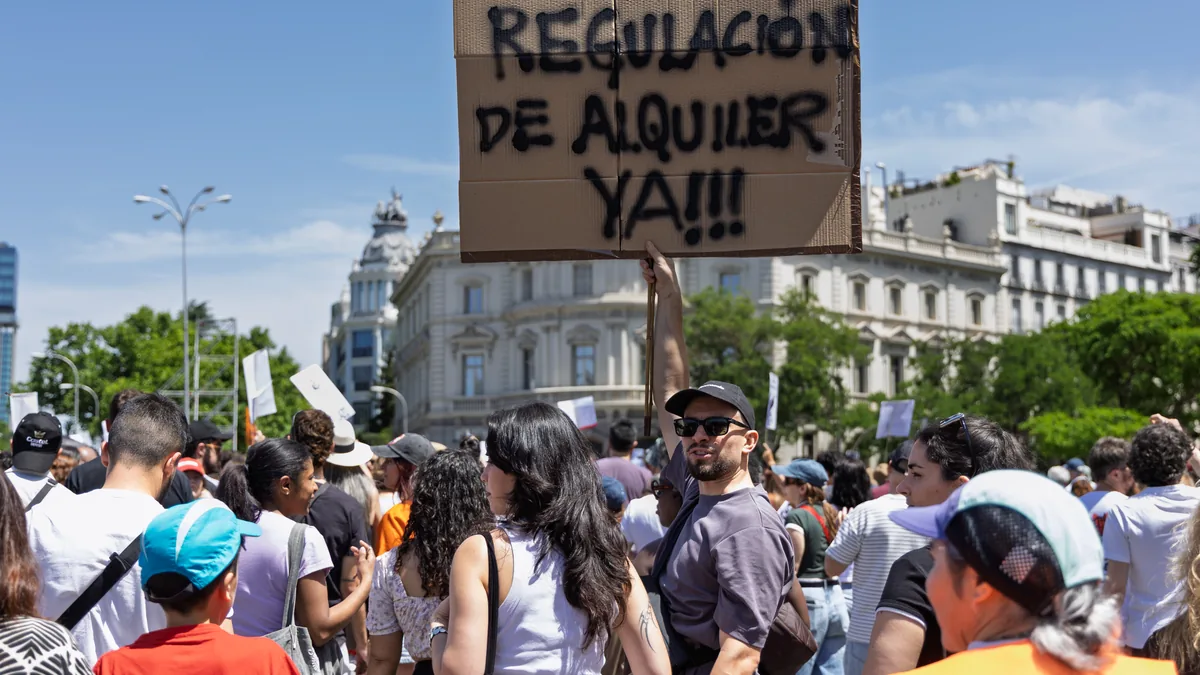
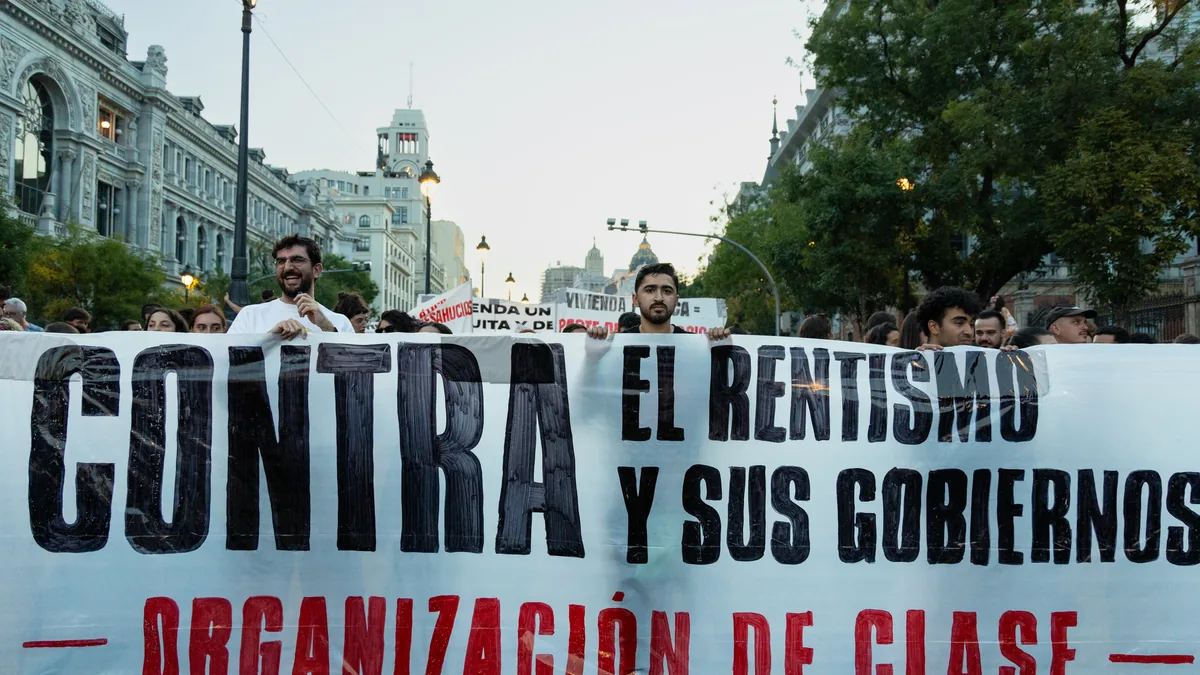
The timing, scope and early effects of the strike were checked against Associated Press reporting from Madrid on Nov. 11. The unions' demands were checked against current UGT and CCOO campaign pages, while the 24-hour period and minimum electricity services were checked against Spain's official gazette. Early participation figures are union claims, not independently verified national estimates, and are labelled accordingly. A bounded actual-event photo search found AP images available for commercial licensing but no current strike photographs with established open reuse rights. The two images used are dated archive/context photographs of Madrid housing demonstrations by Barcex: May 24 and Sept. 26, 2026. They do not depict the Nov. 11 strike. Both are licensed CC BY-SA 4.0; visible people and the Commons personality-rights notice make their use editorial and contextual. Full originals are retained in source. Derivatives were centre-cropped to 1,200 × 675 and converted to WebP at quality 82; no retouching.
Walkout reaches transport and industry
Workers across Spain began a 24-hour general strike on Wednesday, the country's first in 14 years, disrupting roads, public transport and industrial sites. The action was called by the UGT and CCOO union confederations over wages, housing costs and the broader cost of living.
The unions said early stoppages reached 90% at car plants and ports, 85% in meat processing, 82% in waste collection and 75% in the energy sector. Those are organisers' preliminary figures rather than independently verified national participation estimates. Spanish authorities ordered minimum electricity services to protect essential supply during the full-day action.
Housing crisis drives the demands
Housing has moved to the centre of the dispute. Associated Press reported that Spain's average rent has nearly doubled over the past decade, putting pressure on households whose wages have not kept pace. The unions are demanding stronger rent controls, more affordable public housing and higher pay.
UGT is also seeking a 7% increase in the statutory minimum wage for 2027. Its campaign argues that price increases for housing and everyday goods have eroded recent wage gains. CCOO has framed the strike around the same three pressures: salaries, housing and prices.
Election turns strike into a political test
The walkout comes less than three weeks before a national election, raising the political cost for Prime Minister Pedro Sánchez's government. Opposition parties are using the disruption and cost-of-living pressures to challenge the government's record, while the unions say the action is directed at employers and public authorities rather than any single party.
The immediate measure of the strike will be participation outside the unions' strongest sectors and the extent of transport disruption. Its wider effect will depend on whether housing and wages displace other campaign themes before voters cast their ballots.
Sources
6 references
- Associated PressSpain holds first general strike in 14 years over housing and wagesIndependent reporting from Madrid on the strike's early effects, political context and union participation claims. · 2026-11-11
- UGTUGT calls the 11 November general strike for decent wages and housingPrimary statement setting out the union's wage and housing demands. · 2026-10-21
- CCOOGeneral strike: salaries, housing, pricesPrimary campaign page describing the strike's objectives. · 2026-11-11
- Boletín Oficial del EstadoOrder establishing minimum electricity services for the 11 November general strikeOfficial record confirming the full-day strike and essential electricity services. · 2026-11-10
- Wikimedia CommonsMadrid - Demonstration - Housing Is costing us our lives - 260524 131433.jpgArchive context photograph by Barcex, licensed CC BY-SA 4.0. · 2026-05-24
- Wikimedia CommonsMadrid - Demonstration for the right to housing - Not one more Maricarmen - 260926 200746.jpgArchive context photograph by Barcex, licensed CC BY-SA 4.0. · 2026-09-26








