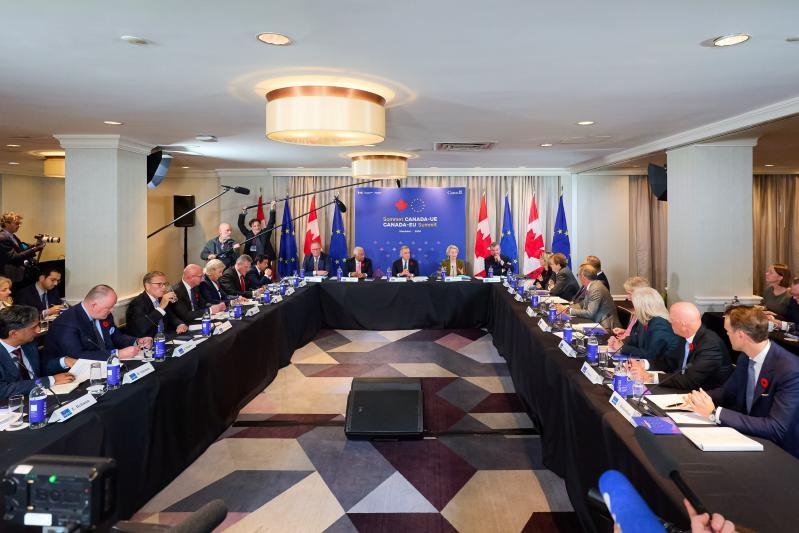
Compared the European Council joint statement and Canada’s summit announcement with separate AP and Le Monde reports. The digital-trade text was described as concluded negotiations, not an agreement already in force. The joint statement does not establish “associate membership”; that status remains a proposal under discussion. Both photographs are actual summit images from the European Commission Audiovisual Service, which licenses EU-owned images CC BY 4.0; they show the Oct. 29 meeting and leaders, not the Oct. 30 closing announcement.
A partnership with practical economic steps
Canada and the European Union launched an “Alliance for the Future” at a summit in Montréal on Oct. 30, pairing a broader political partnership with measures on digital trade, research and supply chains.
The sides said they had completed negotiations on a digital-trade agreement intended to make online transactions easier and clearer for businesses. They also concluded talks on a competition agreement. These are negotiated texts, not evidence that new rules have already taken effect.
Critical minerals, computing and payments
Canada signed a framework allowing the European Investment Bank to finance Canadian critical-minerals projects. Canadian researchers are also set to gain access to the EU’s high-performance computing network, including the JUPITER supercomputer, under the measures announced by Ottawa.
The governments said they would explore links between their instant-payment systems and open talks on access for banks, insurers and financial-technology firms. Those steps remain prospective. The parties also agreed to continue work on student and research exchanges.

Associate status is still a proposal
Prime Minister Mark Carney said he hoped to conclude negotiations in June on making Canada the EU’s first “associate member.” But that label does not appear in the leaders’ joint statement. The statement instead commits them to define an “ever-closer association” by their next summit in 2027, and the details have yet to be agreed.
The distinction matters: Canada is not joining the EU, and the summit did not grant it a new membership status. The partnership builds on the existing Canada-EU trade agreement while seeking to diversify supply chains and cooperation at a time when both sides say economic security has become more important.
Sources
4 references
- European CouncilJoint statement EU-Canada summit, 30 October 2026Official joint statement from the 29–30 October summit · 2026-10-30
- Prime Minister of CanadaCanada and the European Union announce new Alliance for the FutureOfficial summary of the announced measures and negotiations · 2026-10-30
- Associated PressCarney eyes June deal for Canada to become EU associate member as Trump reshapes alliancesIndependent reporting on the summit, trade measures and status of the membership proposal · 2026-10-30
- Le MondeEurope and Canada detail first measures after unprecedented rapprochementIndependent follow-up on the first measures and their implementation limits · 2026-10-31