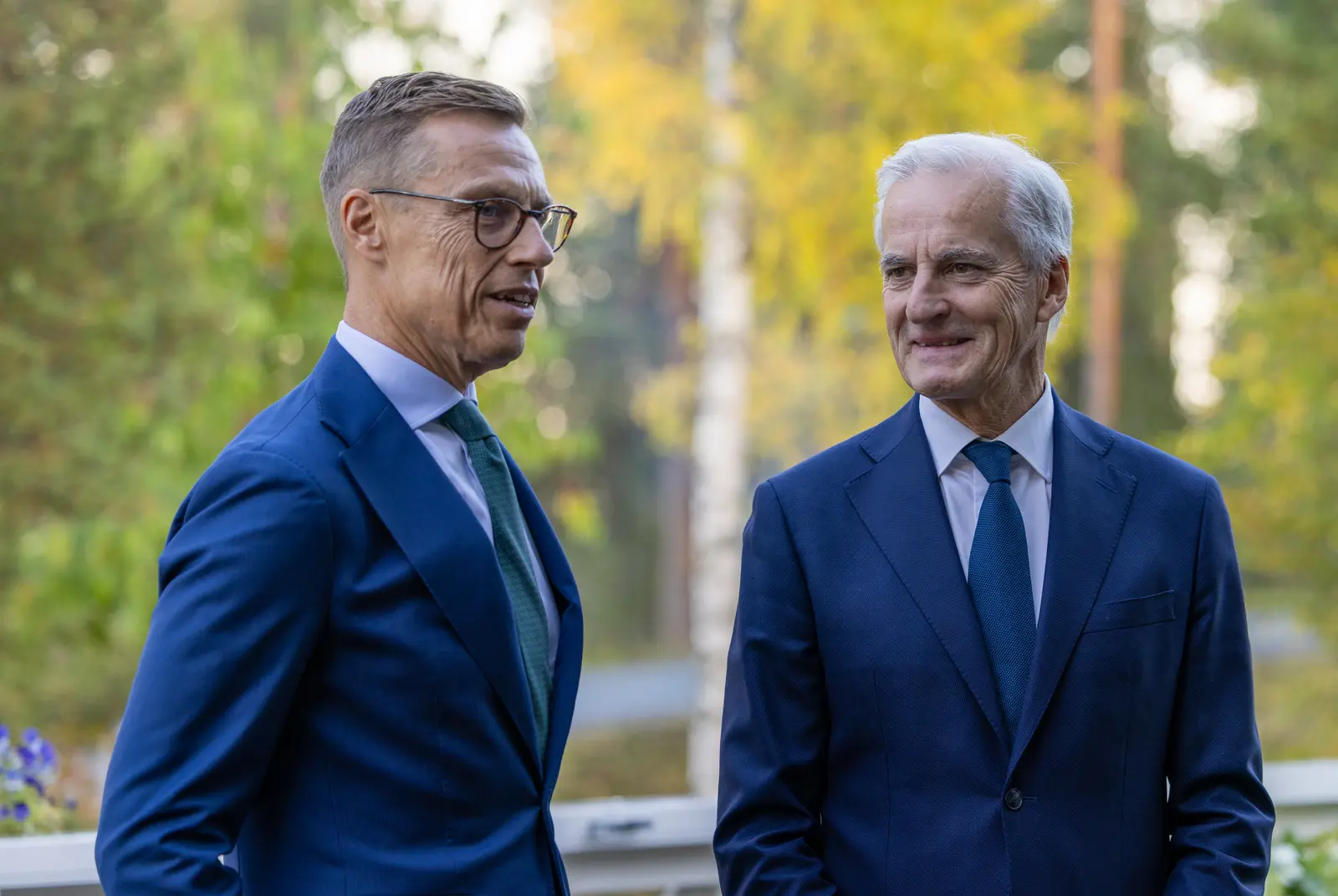
Checked the Finnish president’s and Norwegian government’s October 27 statements, Reuters’ report on the call and reactions, and the Ukrainian president’s office confirmation of the follow-up conversation. The Nordic leaders said they consulted Ukraine and spoke for their own countries, not Europe as a whole. The photograph is from a separate September 13 summit and is labeled as archive context; no verified reuse rights were found for the October 27 call imagery.
A 90-minute call before expected Abu Dhabi talks
Finnish President Alexander Stubb and Norwegian Prime Minister Jonas Gahr Støre called Russian President Vladimir Putin from Helsinki on Tuesday, October 27, in an effort to press for an end to Russia’s war against Ukraine. Støre said the conversation lasted about 90 minutes, Reuters reported.
The leaders said the call followed their October 20 meeting in Oslo and was held in consultation with Ukraine. Their offices said they discussed the war and diplomatic efforts to restore peace and security in Europe. They linked the contact to Russia-Ukraine-US talks expected in Abu Dhabi next month; Reuters reported that the planned discussions would be the first such round since February.
Stubb and Støre said they acted as national leaders and did not represent Europe as a whole. They reiterated support for Ukraine and called for negotiations to resume.
Kyiv was briefed; Moscow signalled no shift
Ukrainian officials confirmed that President Volodymyr Zelenskyy spoke with Stubb and Støre after their call with Putin. Kyiv’s foreign minister welcomed the outreach as coordinated with Ukraine, Reuters reported.
The Kremlin’s account offered no sign that Putin had softened his position. It said any lasting peace would require Russia’s interests to be fully taken into account and blamed EU and NATO policies for prolonging the fighting. Russian Foreign Minister Sergei Lavrov later said the call brought nothing new, according to Reuters.
The initiative also drew questions about European coordination. Denmark’s prime minister said Europe should stay united rather than act alone, while Sweden’s prime minister said other European leaders had not been informed. Stubb and Støre said they had consulted partners.
A change in direct contact, not a negotiated outcome
Most Western European leaders have avoided direct calls with Putin since Russia’s full-scale invasion in February 2022. The Finnish and Norwegian leaders framed their outreach as a channel for messages ahead of the next diplomatic round, not as a negotiation or agreement.
The governments reported no ceasefire, concession or change in the battlefield position as a result of the call. The proposed Abu Dhabi meeting remains a future diplomatic step.
Sources
5 references
- Office of the President of FinlandStubb and Støre held a phone call with PutinPrimary statement; confirms date, location, Ukraine consultation and purpose · 2026-10-27
- Government of NorwayStubb and Støre held a call with President PutinPrimary statement from the Office of the Prime Minister · 2026-10-27
- ReutersTwo Nordic leaders urge Putin to end Ukraine war in rare direct contact by EuropeansIndependent reporting; duration, planned talks, Kremlin readout and allied reactions · 2026-10-27
- Finnish Government / Wikimedia CommonsEuropean Arctic Summit leaders in Rovaniemi, September 13, 2026Image source and item-specific CC BY 4.0 licence · 2026-09-13
- The Associated PressLocalized Ukraine ceasefire brokered by Melania Trump starts as Nordic leaders speak to PutinIndependent reporting; confirms the 90-minute call, expected Abu Dhabi talks and subsequent Zelenskyy call · 2026-10-27