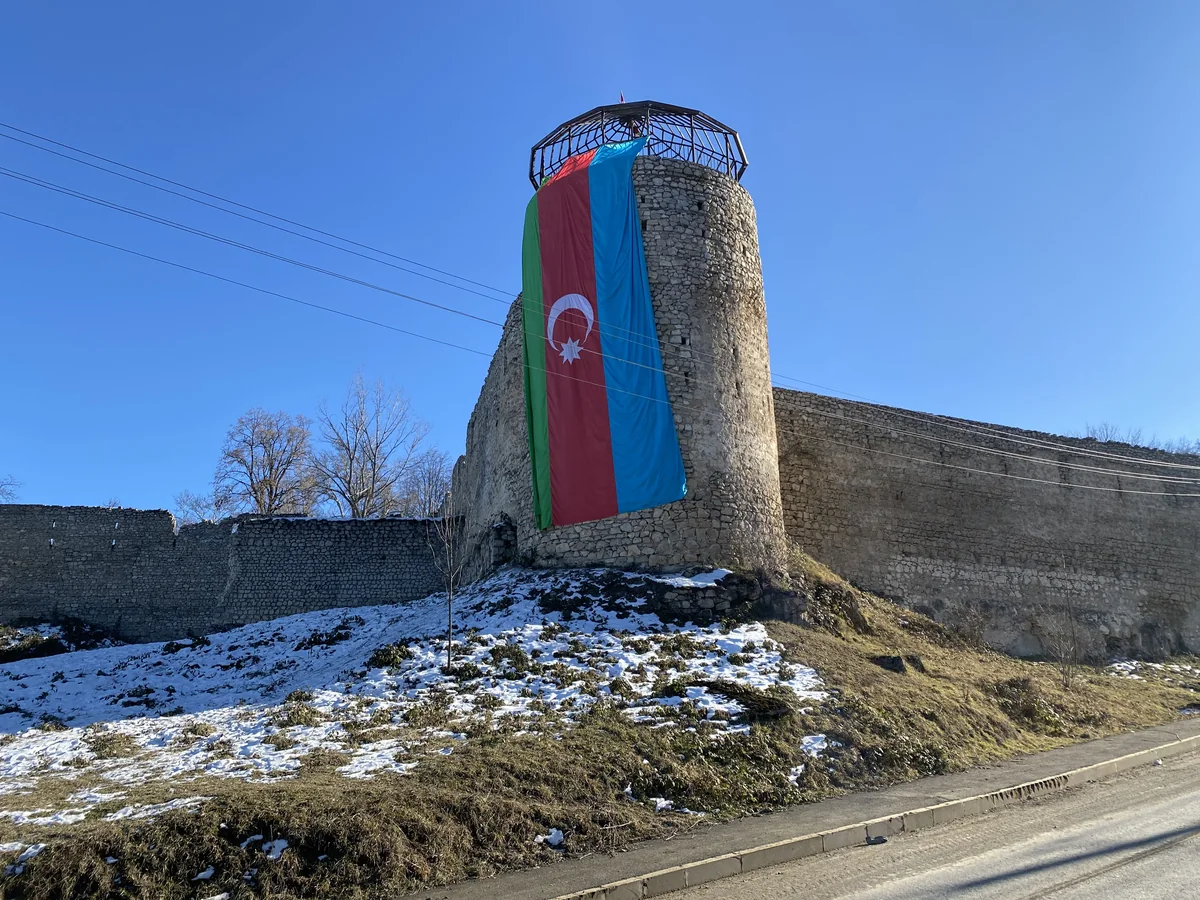
The official website of Azerbaijan's president confirms Erdoğan's Nov. 8 visit to Shusha and publishes the leaders' press statements; APA reproduces the statements. AP and Reuters independently reported the preceding signs of strain, including Azerbaijan's Oct. 30 absence from a Turkic summit, criticism of Azerbaijan's school headscarf restrictions and a reported change involving a Turkish presidential aide. The public statements establish that leaders affirmed the relationship and discussed cooperation; they do not document a new agreement, policy compromise or resolution of the tensions. A bounded search of the official Azerbaijani presidential photo gallery found event pictures but no reuse licence; its pages say all rights reserved. The two images used are archive context only: Shusha Fortress photographed Jan. 5, 2021, and Baku's skyline photographed June 17, 2005. Neither depicts the Nov. 8 visit. Original files, credits, licence terms and modifications are identified below.
A public reset in Shusha
Turkish President Recep Tayyip Erdoğan and Azerbaijani President Ilham Aliyev used a Nov. 8 meeting in Shusha to present their partnership as firm, after months of public signs of strain. The visit included official talks and joint press statements, but the leaders announced no new treaty, policy change or compromise on the issues that had unsettled the relationship.
Shusha, a city retaken by Azerbaijan in the 2020 war with Armenia, gave the meeting a symbolic setting. It also coincided with Azerbaijan's Victory Day commemorations. The visit put the two leaders together in public after Aliyev missed an Oct. 30 gathering of Turkic leaders in Istanbul despite receiving a personal invitation, according to AP and Reuters.
The points of friction remain
The recent tensions included criticism in Turkey over Azerbaijan's restrictions on headscarves in schools. AP reported that Turkish social media users and figures from the ruling party had criticised the rules; Ankara had not issued an official statement on the ban. Reuters also described criticism of the school rules and reported that Erdoğan's aide Oktay Saral had been removed from his post, a move Turkish media linked to easing the dispute.
Those episodes do not establish a formal break between the governments. Before the visit, Erdoğan said the relationship could overcome obstacles. The Shusha meeting is a further public signal that both presidents want to keep the alliance intact, but neither side announced a settlement of the headscarf dispute or a change in Azerbaijan's school policy.
Familiar cooperation, no announced deliverables
In their statements, the leaders described cooperation across political and economic ties, investment, energy and transport. Azerbaijan's official account and APA presented these as subjects discussed, rather than a list of newly signed projects. The distinction matters: a joint appearance can reassure partners and signal continued access, but it does not by itself deliver a new corridor, investment or energy commitment.
For now, the visit has clarified the political message more than the policy outcome. Ankara and Baku publicly reject the suggestion that their close relationship is fraying, while the reported disputes and the absence of any announced resolution remain part of the record.
Sources
4 references
- APAPresidents of Azerbaijan and Türkiye delivered press statementsAzerbaijani official news agency publication of the leaders' statements in Shusha; reports topics discussed, including political and economic ties, investment, energy and transport, without describing a new signed accord. · 2026-11-08
- Associated PressTurkey, Azerbaijan deny speculation about fraying relationshipAP reporting on the visit and the recent signs of strain, including criticism over Azerbaijani school headscarf rules and Azerbaijan's absence from an Oct. 30 Turkic summit. · 2026-11-08
- ReutersErdogan says Turkey-Azerbaijan ties can overcome all obstacles amid growing tensionsIndependent reporting ahead of the Shusha visit on the diplomatic strains, summit absence, criticism of school headscarf restrictions and a reported personnel change in Erdoğan's office. · 2026-11-05
- President of the Republic of AzerbaijanPresidents Ilham Aliyev and Recep Tayyip Erdoğan posed for photographs in front of Shusha FortressPrimary-source event record confirming the leaders were in Shusha on Nov. 8; its photographs are not reused because the page states all rights reserved. · 2026-11-08